
How University Incubators Are Shaping the Future of Student Entrepreneurship
Starting a business as a college student can be exciting, but turning an idea into a practical venture requires much more than enthusiasm. Students often need mentorship, market knowledge, business planning, infrastructure, networking, technical guidance, and access to the right resources. This is where university incubators are becoming increasingly important.
A university incubator creates a bridge between academic learning and entrepreneurship. It gives students an environment where they can explore problems, validate ideas, develop prototypes, receive expert guidance, and gradually understand what it takes to build a business.
For students in India, university-based incubation can be particularly valuable because it connects entrepreneurship education with research, technology, industry exposure, and practical learning. Instead of treating entrepreneurship as only a classroom subject, universities can provide opportunities for students to experience the startup journey directly.
Key Takeaways
- University incubators help students move from ideas toward practical ventures.
- Incubation can include mentorship, business planning, infrastructure, training, networking, and funding assistance.
- Student entrepreneurs can use incubation to validate problems and develop products or services.
- A university startup incubator can connect academic knowledge with real-world business challenges.
- Students do not necessarily need a fully developed company before seeking incubation support.
- The incubation journey generally moves from idea → validation → prototype → mentorship → funding readiness → launch → growth.
- University incubators are becoming important parts of India’s wider innovation and startup ecosystem.
What Is a University Incubator?
A university incubator is a structured entrepreneurship support environment within or connected to a university. It helps students, researchers, faculty members, innovators, and early-stage entrepreneurs develop business ideas and work toward creating viable ventures.
Unlike ordinary academic facilities, a university incubator focuses on applying knowledge to real-world problems. Depending on the program, students may receive access to:
- Mentorship
- Business planning
- Startup consulting
- Co-working infrastructure
- Training and workshops
- Networking opportunities
- Technical guidance
- Product development support
- Funding assistance
- Intellectual property support
The exact services vary between institutions.
How University Incubators Differ From Traditional Business Incubators
Traditional business incubators generally focus on supporting entrepreneurs and early-stage companies. A university business incubator, however, operates within an academic ecosystem.
This creates several additional opportunities.
Students may be able to connect their academic projects, research, technical skills, faculty expertise, and entrepreneurial interests with startup development.
| University Incubator Support | How It Helps Students |
|---|---|
| Mentorship | Helps students understand business decisions |
| Business planning | Converts an idea into a structured model |
| Co-working space | Provides an environment for collaboration |
| Training | Develops entrepreneurial and professional skills |
| Networking | Creates connections with industry and startup professionals |
| Funding assistance | Helps founders understand funding opportunities |
| IPR support | Helps students consider intellectual property protection |
| Prototype support | Helps move concepts toward practical solutions |
What Services Do University Incubators Provide?
There is no single model for incubation. Some university incubators focus on technology startups, while others support social innovation, biotechnology, agriculture, digital businesses, engineering, or multiple sectors.
The most useful programs combine infrastructure with knowledge and guidance. This allows students to work not only on their ideas but also on the business skills required to develop them.
Why Student Entrepreneurship Is Growing
Student entrepreneurship is becoming an increasingly relevant part of higher education. Students are exposed to digital platforms, emerging technologies, online businesses, research opportunities, startup communities, and new career models.
Entrepreneurship can therefore become one possible path alongside traditional employment.
Changing Career Goals Among Students
Students today can explore careers beyond conventional job roles.
A student with knowledge of computer science may develop a software product. A business student may identify a market gap and create a digital service. An engineering student may develop a technology-based solution. Students from different disciplines can also collaborate to build interdisciplinary ventures.
This does not mean every student should become an entrepreneur. Rather, entrepreneurship education gives students another way to develop problem-solving, communication, leadership, and business skills.
The Role of Innovation and Technology
AI, cloud computing, automation, biotechnology, digital platforms, data analytics, and other emerging technologies are creating new opportunities for innovation.
Students can experiment with these technologies while still in university.
A university incubator can help them move beyond the technology itself by asking important business questions:
- Who needs this solution?
- What problem does it solve?
- How large is the potential market?
- What alternatives already exist?
- How will customers access it?
- How can the startup generate revenue?
Why Universities Are Supporting Student Startups
Universities are increasingly recognizing that innovation can extend beyond academic research.
An effective entrepreneurship ecosystem can connect:
Education → Research → Innovation → Mentorship → Incubation → Market Readiness
This connection can help students understand how knowledge can be transformed into practical solutions.
How University Incubators Support Student Entrepreneurs
The main value of a student startup incubator is structured support.
Students may have enthusiasm and technical knowledge but lack experience in areas such as pricing, customer research, business models, fundraising, intellectual property, or market strategy.
Mentorship and Expert Guidance
Mentorship gives student entrepreneurs an opportunity to discuss their ideas with experienced professionals.
A mentor can challenge assumptions, identify weaknesses, suggest improvements, and help founders understand practical business decisions.
Good mentorship does not mean someone builds the startup for the student. Instead, it helps the founder make better-informed decisions.
Business Planning and Startup Strategy
A strong idea needs a clear business model.
Students can work on:
- Target customers
- Value proposition
- Revenue model
- Pricing
- Competition
- Distribution
- Operating costs
- Growth strategy
This process helps turn a broad idea into a more structured startup concept.
Co-Working Spaces and Infrastructure
Infrastructure can be especially useful for students who do not have access to professional workspaces.
University incubation centers may provide offices, meeting rooms, collaborative areas, equipment, or other facilities depending on the incubator.
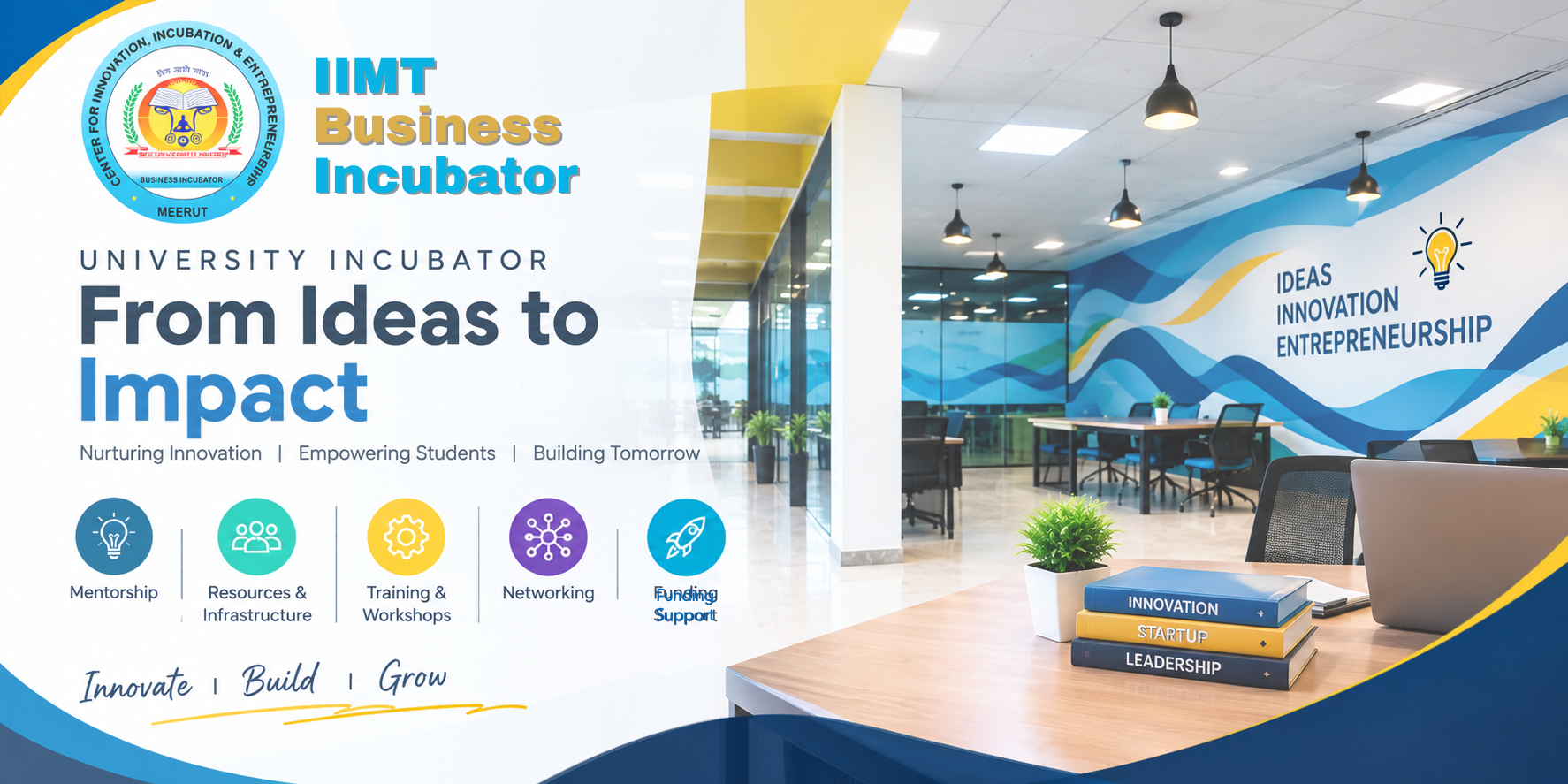
The IIMT Business Incubator Foundation, for example, describes infrastructure support including office space and meeting rooms for candidates.
Prototype and Product Development Support
A startup idea becomes easier to evaluate when students can build something tangible.
Depending on the sector, this could be:
- A software prototype
- Mobile application
- Hardware model
- Website
- Digital platform
- Product sample
- Research-based solution
The goal is to move from assumptions toward something that can be tested with potential users.
Funding Assistance and Investor Connections
Funding is an important consideration for many early-stage startups.
University incubators may help entrepreneurs understand different funding routes, prepare for investment discussions, and identify relevant opportunities.
However, incubation support does not guarantee funding. Funding depends on the startup, program, eligibility, investor requirements, market opportunity, and other factors.
IIMT Business Incubator Foundation lists funding assistance among its services.
Training, Workshops and Skill Development
Entrepreneurship requires skills that may not always be covered in a conventional classroom.
Training can cover:
- Business planning
- Pitching
- Market research
- Leadership
- Digital marketing
- Financial awareness
- Startup strategy
- Product development
- Communication
Training can help students become more confident in discussing and developing their ideas.
Networking and Industry Connections
Entrepreneurship rarely happens in isolation.
Students benefit from meeting:
- Founders
- Mentors
- Investors
- Industry professionals
- Researchers
- Other student entrepreneurs
- Potential collaborators
These connections can introduce students to perspectives and opportunities that may not be available through classroom learning alone.
Intellectual Property and IPR Support
Innovation can involve intellectual property such as patents, trademarks, copyrights, or other forms of protection.
Students developing original technology or creative products should understand whether intellectual property protection is relevant to their work.
IIMT Business Incubator Foundation lists IPR support that includes assistance related to patents, trademarks, and copyright protection.
Benefits of University Incubators for Students
The benefits of university incubation extend beyond launching a company.
Turning Ideas Into Practical Solutions
Many student ideas remain projects because there is no structured process for developing them.
Incubation introduces students to a practical progression:
Problem → Idea → Validation → Prototype → Feedback → Business Model → Market
This encourages students to test assumptions instead of immediately investing heavily in an unvalidated idea.
Developing Entrepreneurial Skills
Students can develop:
- Critical thinking
- Leadership
- Communication
- Negotiation
- Decision-making
- Problem-solving
- Market research
- Financial awareness
- Team management
These skills can also be valuable for students who eventually choose employment rather than entrepreneurship.
Getting Real-World Business Experience
Classroom learning explains concepts. Startup projects allow students to experience them.
For example, a student may learn marketing theory and then apply it by researching customers for a startup idea.
This creates a stronger connection between education and real-world application.
Reducing Early-Stage Startup Challenges
First-time founders often struggle because they do not know what they do not know.
Mentorship and incubation can help identify potential problems earlier.
Building Professional Networks
A university entrepreneurship ecosystem can help students build relationships with mentors, entrepreneurs, researchers, industry professionals, and other founders.
Improving Startup Readiness
Incubation can help students become better prepared for the next stage of their venture.
This may involve improving the business model, developing an MVP, preparing a pitch, understanding the market, or identifying funding requirements.
From Student Idea to Startup: How the Incubation Journey Works
A student startup does not usually emerge overnight. It develops through a series of stages.
Step 1: Identify a Real Problem
Start with a problem rather than simply starting with a technology.
Ask:
Who has the problem, how frequently does it occur, and why are existing solutions insufficient?
Step 2: Develop and Validate the Idea
Research customers and competitors.
Talk to potential users and collect feedback.
Validation may show that the original idea needs to change. That is a useful outcome, not a failure.
Step 3: Build a Business Model
Determine:
- Who will pay?
- What will they pay for?
- How will the product reach them?
- What will it cost to operate?
- What resources are required?
Step 4: Create a Prototype or Minimum Viable Product
Build the simplest useful version of the solution.
The objective is learning, not perfection.
Step 5: Receive Mentorship and Feedback
Share the idea, prototype, and business model with mentors.
Feedback can reveal weaknesses and opportunities.
Step 6: Explore Funding Opportunities
Once the startup demonstrates stronger validation, founders can explore appropriate funding options.
These may include grants, competitions, institutional support, investors, or other eligible programs.
Step 7: Launch and Scale the Startup
After sufficient validation, the venture can move toward market launch.
Growth should be based on evidence such as customer demand, product performance, revenue, partnerships, and operational capability.
Role of University Incubators in India’s Startup Ecosystem
India’s startup ecosystem includes universities, incubators, accelerators, government initiatives, investors, industry organizations, researchers, and entrepreneurs.
University incubators can contribute by bringing this ecosystem closer to students.
Supporting Innovation in Higher Education
Students can transform academic knowledge into practical experiments, prototypes, and ventures.
Connecting Students With Industry
Industry interaction exposes students to real business problems and market expectations.
Encouraging Technology-Based Startups
University ecosystems can provide an environment where students experiment with emerging technologies and research-driven ideas.
Creating Future Entrepreneurs and Job Creators
Not every startup succeeds, but entrepreneurship education can help students understand how businesses are built and how organizations create value.
The objective should therefore be broader than simply counting startups. It should include developing capable, informed, and adaptable entrepreneurs.
How IIMT Business Incubator Supports Student Entrepreneurship
The IIMT Business Incubator Foundation (IIMT-BIF) is part of the IIMT University innovation and entrepreneurship ecosystem in Meerut. According to its official information, the foundation was established in 2015 and focuses on helping aspiring entrepreneurs develop business ideas toward commercial startups. It also describes mentorship and infrastructure support for candidates.
For students and early-stage entrepreneurs, the ecosystem provides several areas of support.
Mentorship and Business Guidance
IIMT-BIF provides mentoring and business support designed to help entrepreneurs understand business development and early-stage challenges.
Its services include business support and consulting and mentoring support.
Students can use this type of support to discuss business models, startup challenges, strategy, and development requirements.
Infrastructure and Co-Working Support
IIMT-BIF lists co-working spaces with office infrastructure, equipment, and utilities for startup cohorts.
For student entrepreneurs, access to a collaborative working environment can make it easier to work with teammates, mentors, and other founders.
Funding Assistance
Funding assistance is another service listed by IIMT-BIF. Its official services page describes support intended to help startups with their early-stage funding requirements.
Students should understand that funding assistance is not the same as guaranteed funding. A startup’s eligibility and funding outcome depend on its circumstances and the relevant funding opportunity.
Training and Skill Development
IIMT-BIF lists training and workforce development among its services and emphasizes opportunities to connect students with real-world learning experiences.
This is important because student entrepreneurship requires more than an idea. Founders also need communication, planning, market understanding, leadership, and business skills.
IPR and Intellectual Property Support
IIMT-BIF also provides IPR support covering areas such as patents, trademarks, and copyright protection.
For students developing original products, technologies, or creative assets, understanding intellectual property can be an important part of startup preparation.
Industry and Startup Networking
Networking gives student founders opportunities to interact with entrepreneurs, professionals, mentors, and other members of the innovation ecosystem.
IIMT-BIF’s broader ecosystem emphasizes networking and collaboration as part of its startup support.
Students interested in the ecosystem can also explore the official information about business incubation and the IIMT Business Incubator services.
How Students Can Prepare for a University Incubator Program
Students do not need to have a perfect startup before approaching an incubator. However, preparation can make discussions with mentors more productive.
Identify a Real-World Problem
Clearly explain the problem you want to solve.
Research the Target Market
Understand potential customers, competitors, existing solutions, and market requirements.
Develop a Clear Business Idea
Explain your proposed solution in simple language.
Build a Basic Prototype or MVP
If possible, create an early version that demonstrates the concept.
Prepare a Business Pitch
Your pitch should explain:
- Problem
- Solution
- Target customer
- Market opportunity
- Business model
- Current progress
- Team
- Support required
Be Ready to Learn From Mentors
An incubator is not simply a place to get resources. It is an environment for learning and improving.
Students should be willing to change their assumptions when evidence and expert feedback suggest a better direction.
For additional preparation, students can also explore a practical guide on how to join a business incubator.
Challenges Student Entrepreneurs May Face
University incubation can provide support, but students still need to overcome significant challenges.
Lack of Experience
First-time founders may not understand customers, finance, operations, or sales.
Solution: seek mentorship and learn through practical experimentation.
Limited Funding
Students may have limited financial resources.
Solution: validate the idea before making major investments and explore appropriate funding opportunities.
Balancing Academics and Entrepreneurship
Managing coursework alongside a startup can be difficult.
Solution: create realistic schedules and establish clear priorities.
Market Validation Challenges
Students may become emotionally attached to their ideas.
Solution: allow customer feedback and evidence to guide development.
Building the Right Team
A strong technical idea still needs business, marketing, operations, or domain expertise.
Solution: build complementary teams instead of selecting members only because they are friends.
Future of University Incubators and Student Entrepreneurship
The future of university incubators will likely be influenced by rapid technological and economic change.
AI and Emerging Technologies
Artificial intelligence is opening new possibilities for software, education, healthcare, automation, research, marketing, and business operations.
Students will increasingly experiment with AI-powered products and services.
Deep-Tech Startups
University research can become a source of deep-tech innovation in areas such as biotechnology, advanced engineering, materials, computing, and healthcare.
University-Industry Collaboration
Stronger university-industry relationships can expose students to real business problems and create opportunities for research commercialization.
Innovation Ecosystems
The future will depend less on isolated incubators and more on connected ecosystems involving universities, companies, government organizations, investors, mentors, researchers, and founders.
Digital Entrepreneurship
Students can now reach customers beyond their local geography through digital platforms.
This creates opportunities for software businesses, online services, creator-led businesses, e-commerce, SaaS, and other digital ventures.
Sustainable Startups
Environmental and social challenges can become sources of entrepreneurial innovation.
Student founders can explore solutions related to clean technology, sustainable agriculture, waste management, energy efficiency, and social impact.
Technology Commercialization
Universities generate knowledge and research. Incubation can help explore whether that knowledge can be converted into practical products or services.
Student-Led Ventures
Students are likely to remain an important source of new ideas because they are exposed to emerging technologies, changing consumer behavior, and problems within their own communities.
Entrepreneurship Education
Entrepreneurship education will increasingly need to move beyond textbooks.
Students benefit when they can combine:
Learn → Experiment → Validate → Build → Receive Feedback → Improve
That learning cycle can make entrepreneurship education more practical.
Frequently Asked Questions About University Incubators
What is a university incubator?
A university incubator is a structured environment that helps students, researchers, and early-stage entrepreneurs develop business ideas through mentorship, infrastructure, training, networking, and other startup support.
How does a university incubator help students?
It can help students validate ideas, develop business models, build prototypes, receive mentorship, access infrastructure, develop entrepreneurial skills, and connect with relevant networks.
What are the benefits of university incubators?
Major benefits include mentorship, practical business experience, networking, infrastructure, training, startup guidance, and potential access to funding-related opportunities.
Can college students start a startup?
Yes. College students can develop startups while studying if they can manage academic responsibilities and have a viable problem, solution, team, and development plan.
How can students join a business incubator?
Students should research the incubator’s current eligibility and application process, prepare a clear explanation of their idea, and contact the incubator for current program information.
What support does a student startup incubator provide?
Support varies, but it can include mentoring, business consulting, co-working space, training, networking, product development guidance, funding assistance, and IPR support.
Do university incubators provide funding?
Some incubators provide funding assistance or connect startups with relevant opportunities. However, funding is not guaranteed and depends on eligibility, startup readiness, and the specific funding program.
Why is student entrepreneurship important?
Student entrepreneurship gives young people an opportunity to apply academic knowledge to real-world problems while developing skills such as innovation, leadership, communication, decision-making, and business planning.
Conclusion: Building the Next Generation of Student Entrepreneurs
University incubators are becoming an important bridge between education and entrepreneurship. They can give students access to mentorship, infrastructure, training, networking, business guidance, and other resources that are difficult to develop independently.
For student entrepreneurs, the journey should not be viewed simply as having an idea and starting a company. A stronger approach is to identify a genuine problem, validate the opportunity, build a prototype, learn from mentors, understand the market, explore appropriate funding opportunities, and gradually move toward launch and growth.
In India, university-based incubation can also strengthen the connection between education, innovation, research, industry, and entrepreneurship.
The IIMT Business Incubator Foundation provides an example of this university-linked approach in Meerut, with official services including business support and consulting, co-working infrastructure, mentoring, funding assistance, training and workforce development, and IPR support.
For students with entrepreneurial ambitions, the most important first step is not necessarily to build a company immediately. It is to learn how to turn a problem into a validated solution and understand what support is needed to develop it further.
That is where a strong university incubation ecosystem can make a meaningful difference.