
The Strategic Importance of University Business Incubators for Scaling Startups in Tier 2 and Tier 3 Cities in India
As we move through 2026, the Indian startup landscape has undergone a monumental shift. No longer restricted to the bustling tech corridors of Bangalore, Mumbai, or Gurgaon, the next wave of innovation is emerging from “Bharat”—our Tier 2 and Tier 3 cities. However, entrepreneurs in these regions often face unique hurdles, including limited access to high-end infrastructure, specialized mentorship, and institutional funding. University Business Incubators have emerged as the vital bridge connecting local talent with global opportunities.
This article explores how institutional support systems, such as the IIMT Business Incubator Foundation (IIMT BIF), are transforming regional economies. We will analyze the strategic role these hubs play in providing the necessary resources for local founders to scale their ventures without having to migrate to expensive metropolitan hubs. From infrastructure to skill development, discover why the university ecosystem is the powerhouse of regional startup growth in India today.
Quick Verdict
University Business Incubators are the essential catalysts for regional growth, providing Tier 2 and Tier 3 startups with low-cost infrastructure, academic expertise, and direct links to government funding, which effectively levels the playing field against metro-based competitors.
Quick Overview
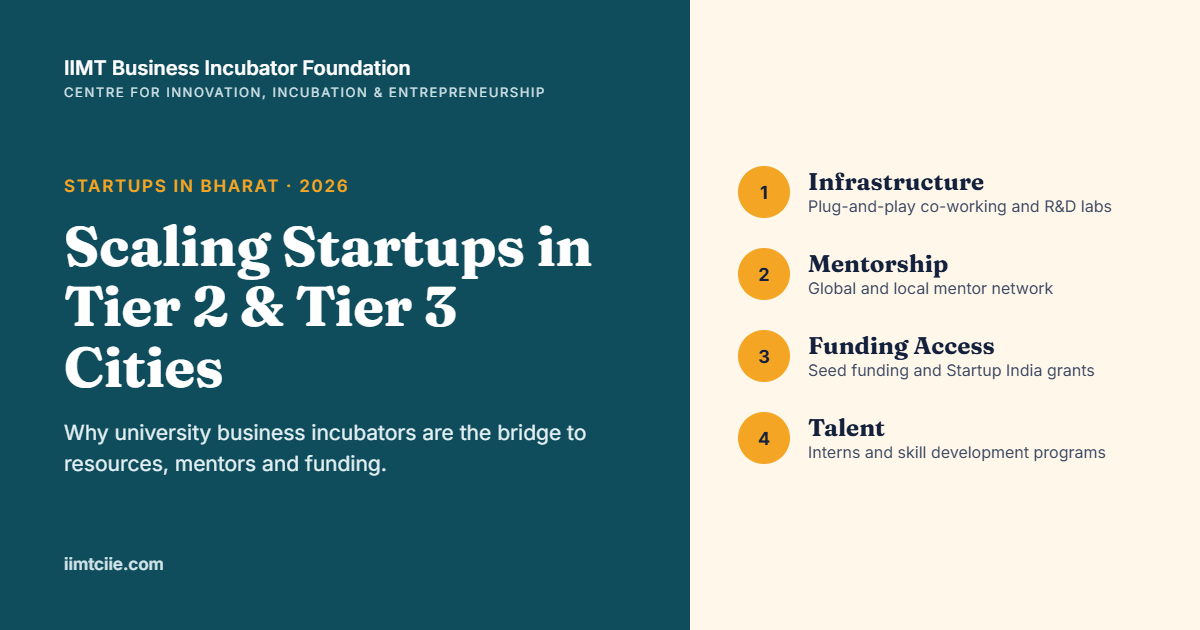
| Feature | Impact on Tier 2/3 Startups | Role of Incubators (e.g., IIMT BIF) |
|---|---|---|
| Infrastructure | Reduces massive initial CapEx for offices/labs. | Provides plug-and-play co-working spaces and R&D facilities. |
| Mentorship | Provides industry expertise missing locally. | Connects founders with a network of global and local mentors. |
| Funding Access | Bridges the gap to VC and Angel networks. | Facilitates seed funding and government grants (Startup India). |
| Talent Acquisition | Easy access to fresh student talent. | Facilitates internships and specialized skill development. |
01. Bridging the Resource Gap in Regional India
In Tier 2 cities like Meerut, the primary challenge for a founder isn’t a lack of ideas, but a lack of specialized environment. While a startup in a metro might easily find a specialized AI lab or a hardware prototyping center, a regional founder traditionally had to travel hundreds of kilometers for the same. University Business Incubators solve this by leveraging existing academic resources for commercial innovation.
By hosting incubators within university premises, institutions offer startups access to sophisticated laboratories, high-speed internet, and academic libraries. This “shared economy” model significantly lowers the burn rate for early-stage companies. For instance, IIMT BIF provides an ecosystem where innovators can focus on product-market fit rather than worrying about electricity bills or high commercial rents. This strategic advantage allows regional startups to sustain longer during the critical early years.
Furthermore, these incubators serve as a “safe zone” for experimentation. Aspiring entrepreneurs, particularly students, can test their startup ideas for college students in a supportive environment. The proximity to faculty members also ensures that technical roadblocks are addressed through scientific expertise, a resource that is often overpriced in the open market.
02. The Power of Mentorship and Local Ecosystems
A significant part of what a business incubator does involves mentorship. In Tier 2 and Tier 3 cities, the lack of a “startup culture” can lead to isolation for founders. University-led incubators act as a physical hub where like-minded individuals meet, share challenges, and collaborate. This social capital is as important as financial capital.
Access to Global Networks from Local Hubs
In 2026, networking is no longer bound by geography, but it requires a gateway. University incubators act as that gateway. Through dedicated mentors and professional networks, regional startups are introduced to industry leaders they might never meet otherwise. This includes legal advice, IP management, and market entry strategies that are tailor-made for the Indian market context.
Skill Development and Workforce Readiness
Scaling a startup requires a skilled team. One of the strategic advantages of being located within a university is the steady supply of internship-ready talent. Incubators facilitate this synergy by organizing skill development programs. This ensures that the local workforce is trained in modern technologies like AI, Blockchain, and Sustainable Energy, which are crucial for the startups of 2026. This creates a circular economy: the university produces talent, the incubator nurtures the startup, and the startup provides jobs for the graduates.
03. Strategic Importance of University Business Incubators for Funding
The funding landscape in India has become more decentralized, but institutional backing remains a hallmark of credibility. For a startup in a Tier 2 city, an incubation certificate from a recognized body like IIMT Business Incubator Foundation can be the key to unlocking government support. Many state and central schemes, such as the UP Startup Policy or the Startup India Seed Fund Scheme (SISFS), often prioritize startups that are mentored by recognized incubators.
Incubators help founders navigate the complex documentation required for how to register a startup in India and applying for tax exemptions. This hand-holding is crucial for founders who may not have a background in finance or law. By the year 2026, the process has become largely digital, yet the strategic advice on “pitching” and “valuation” provided by an incubator remains indispensable for securing investment.
Moreover, incubators often have their own seed funds or partnerships with local angel investor networks. This localized funding ecosystem is essential for “pre-seed” stages where the risk is highest and traditional VCs are usually hesitant to step in. The incubator’s endorsement acts as a de-risking mechanism for investors, signaling that the startup has been vetted and supported by an academic and professional structure.
04. Step-by-Step Guide: Scaling via a University Incubator
- Self-Assessment: Evaluate if your business model requires technical infrastructure or academic mentorship. University incubators are ideal for deep-tech, agri-tech, and social impact startups.
- Select the Right Partner: Research incubators that align with your industry. If you are based in or near Meerut, exploring the services at IIMT BIF is a logical first step.
- Application & Pitching: Prepare a robust pitch deck focusing on the problem you are solving in the Tier 2/3 context. Learn how to join a business incubator by focusing on your MVP (Minimum Viable Product).
- Utilization of Resources: Once incubated, do not just use the office space. Actively participate in networking events, seek faculty advice, and hire interns from the host university.
- Scaling & Graduation: Use the incubation period (usually 18-36 months) to achieve product-market fit and secure your first round of external funding before moving to a larger commercial space.
05. Frequently Asked Questions
Why are Tier 2 and Tier 3 cities becoming startup hubs?
Lower operational costs, untapped local markets, and a reverse migration of skilled professionals are driving this growth. University incubators provide the infrastructure needed to support this burgeoning talent locally.
Do I need to be a student to join a University Business Incubator?
While many prioritize students, most incubators like IIMT BIF are open to external entrepreneurs and innovators who bring a viable business idea that can benefit from the academic ecosystem.
How does an incubator help with government grants?
Incubators provide the necessary “Incubation Letter” and mentorship certification required for many Startup India schemes. They also assist in drafting technical proposals and financial projections for grant applications.
What is the typical duration of an incubation program?
Most programs last between 1 to 3 years. The goal is to nurture the startup until it is “investment-ready” or sustainable enough to survive in the open market independently.
06. Conclusion
The rise of startups in Tier 2 and Tier 3 cities is not just a trend; it is the future of the Indian economy in 2026. University Business Incubators play a strategic role in this transformation by democratizing access to high-quality resources, mentorship, and funding. By rooting innovation within educational institutions, we are ensuring that the next “Unicorn” could very well emerge from a classroom in Meerut or a laboratory in a regional town. If you are a founder looking to scale, the support of an institutional incubator like IIMT BIF can provide the foundation you need to turn your vision into a viable business entity.
Next Step: Start Your Entrepreneurial Journey Today
Start your entrepreneurial journey today by applying for professional support at IIMT BIF using the incubation application form or explore our specialized services for startups.
Visit: iimtciie.com
IIMT BUSINESS INCUBATOR FOUNDATION
Supporting Innovation | Encouraging Entrepreneurship