
A student project can become a prototype, a startup product, a recognised brand or a creative work. But when an idea begins to take commercial shape, founders need to understand who owns the work and how it can be protected. Intellectual Property Rights (IPR) help creators and businesses protect eligible inventions, brand identities, designs and original creative works. This guide explains the main forms of IPR in India and the practical steps student entrepreneurs and innovators can take before presenting, publishing or commercialising their work.
Focus: Intellectual Property Rights for student innovators and entrepreneurs in India
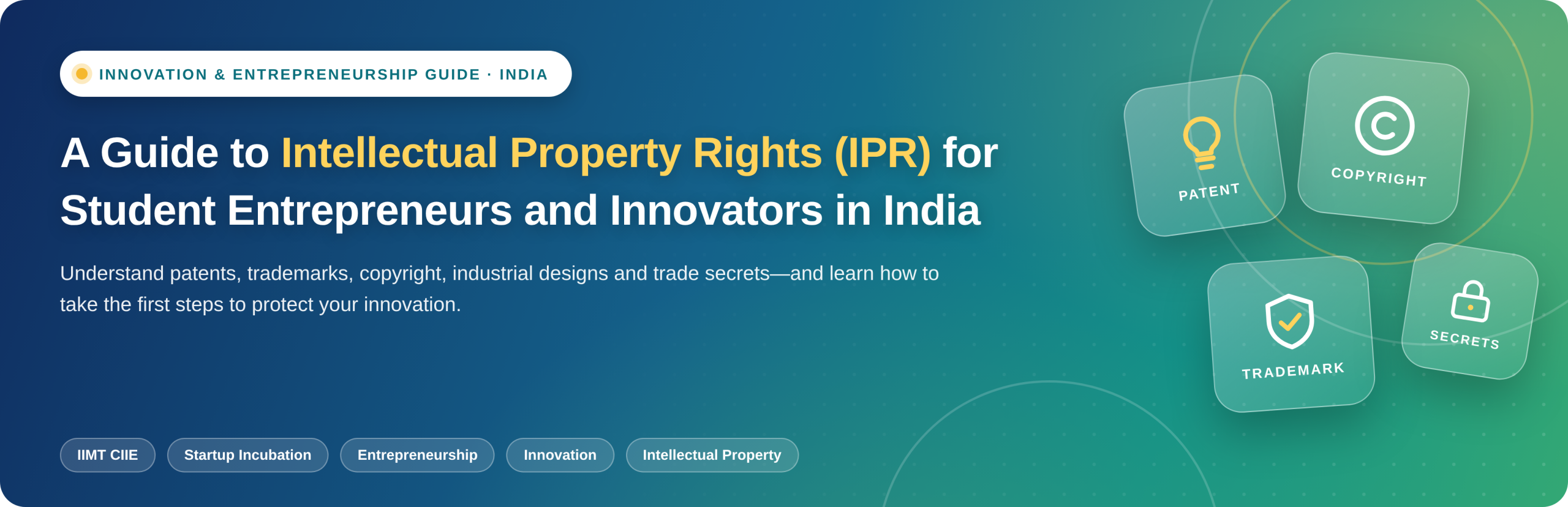
INNOVATION & ENTREPRENEURSHIP GUIDE · INDIA
Patents
Protect qualifying new inventions and processes that meet legal requirements.
Trademarks
Help distinguish a startup’s brand name, logo or other eligible mark.
Copyright
Protects original expression such as written work, artwork and qualifying software code.
Important Before You Disclose an Invention
Publicly presenting, publishing, selling or demonstrating an invention before seeking patent advice can affect whether it is considered new. Before a hackathon, exhibition, pitch event, social-media post or public demo, check the disclosure rules and consider speaking to a qualified IP professional.
In This Guide
- What Are Intellectual Property Rights?
- Why IPR Matters for Student Entrepreneurs
- Main Types of IPR in India
- Which IP Protection May Fit Your Project?
- Patent Basics and Filing Journey
- Trademark Basics for a Startup Brand
- Copyright for Content, Software and Creative Work
- Industrial Design Protection
- Trade Secrets and Confidential Information
- IPR Checklist for Students
- IP Support and Resources
- Frequently Asked Questions
1. What Are Intellectual Property Rights (IPR)?
Intellectual Property (IP) refers to creations of the human mind. These may include inventions, product designs, business names, logos, software, written material, photographs, music and other original creative works. Intellectual Property Rights are legal rights that may allow the owner or authorised rights-holder to control specified uses of protected IP.
IPR does not mean that every idea is automatically protected in every form. Different types of IP protect different subject matter, and each has its own eligibility rules, registration process, duration and limitations. For example, a patent may protect a qualifying technical invention, while copyright protects the original expression of an idea—not the underlying idea itself.
For a student founder, understanding these differences early can help avoid ownership disputes, accidental disclosure and unnecessary filing costs.
2. Why Does IPR Matter for Student Entrepreneurs and Innovators?
Students often create projects in teams, laboratories, innovation clubs, hackathons and incubation programmes. Some projects remain academic submissions; others may develop into products or businesses. IPR planning helps teams understand how their work can be protected and responsibly used.
- Protect original work: Identify whether an invention, brand, design, code or creative output may qualify for legal protection.
- Clarify ownership: Record who contributed, who owns the work and whether the institution, sponsor or collaborator has any contractual rights.
- Support commercialisation: Protected IP may be licensed, assigned or used as part of a commercial business strategy, subject to applicable law and agreements.
- Build brand identity: A distinctive and properly cleared name or logo can help customers identify a startup’s goods or services.
- Prepare for partnerships and investment: Clear records of ownership, permissions and filings can help during due diligence and collaboration discussions.
- Reduce avoidable disputes: Written agreements and documented contributions can prevent confusion when a student team changes or a project moves beyond campus.
3. Main Types of Intellectual Property Rights in India
The following categories are especially relevant to student innovators and early-stage startups. A single product or business may involve more than one type of IP protection.
| IP Category | What It Can Protect | Student/Startup Example | Typical Indian Protection Period |
|---|---|---|---|
| Patent | A qualifying new product or process involving an inventive step and capable of industrial application, subject to statutory exclusions. | A novel technical mechanism, device or qualifying manufacturing process. | Generally 20 years from the filing date, subject to law and renewal fees. |
| Trademark | Distinctive signs that identify the source of goods or services, such as a name or logo. | Startup name, product brand or logo. | 10 years; renewable for further 10-year periods. |
| Copyright | Original literary, dramatic, musical and artistic works, films and sound recordings; includes qualifying computer programs. | Original source code, website text, illustrations, videos or learning material. | Varies by work and author/owner; many author-created works generally last for the author’s lifetime plus 60 years. |
| Industrial Design | Visual features such as shape, configuration, pattern or ornamentation applied to an article, judged by the eye. | Distinctive product casing, packaging shape or ornamental product appearance. | Initially 10 years, extendable by 5 years. |
| Geographical Indication (GI) | Goods whose qualities, reputation or characteristics are linked to a specific geographical origin. | A qualifying regional product made by eligible producers in a defined region. | 10 years; renewable for further 10-year periods. |
| Trade Secret | Valuable business information kept secret through reasonable confidentiality measures. | Non-public formula, process, customer information or business strategy. | No fixed registration term; depends on maintaining secrecy and applicable legal remedies. |
These periods are general summaries, not a substitute for checking the relevant statute and current official guidance. Copyright duration in particular depends on the category of work and ownership circumstances.
4. Which IP Protection May Fit Your Student Project?
Start by identifying what you have actually created. A project can contain several assets, and each may need a different approach.
| Your Project Asset | Possible IP Route | First Question to Ask |
|---|---|---|
| New technical device, method or process | Patent assessment | Is it new, inventive and industrially applicable, and is it excluded by law? |
| Startup name, logo or product name | Trademark search and filing | Is the mark distinctive and available for the relevant goods/services? |
| App source code, written content, graphics or videos | Copyright and ownership documentation | Who created it, and are third-party or open-source materials included? |
| Product’s ornamental shape or appearance | Industrial design registration | Is the visual design new/original and not already publicly disclosed? |
| Secret formula, dataset or internal process | Confidentiality and trade-secret measures | Who can access it, and how is secrecy protected? |
These are starting points, not automatic classifications. For example, a software-based product may involve copyright in its code, a trademark for its brand and potentially patent issues if it includes a qualifying technical invention. Patentability of software-related inventions in India is legally complex and should be assessed by a patent professional against the Patents Act and applicable examination guidance.
5. Patent Basics: Protecting a Technical Invention
A patent is an exclusive right granted for an invention that meets the legal requirements. In India, the Patents Act, 1970 requires an invention to be new, involve an inventive step and be capable of industrial application. The invention must also not fall within statutory exclusions, including relevant provisions of Sections 3 and 4.
Core Patentability Requirements
- Novelty: The invention must be new; prior public disclosures may affect this requirement.
- Inventive step: It must involve a technical advance or economic significance and not be obvious to a person skilled in the relevant field.
- Industrial applicability: It must be capable of being made or used in an industry.
- No statutory exclusion: The claimed subject matter must not be excluded from patentability under the Act.
Practical Patent Filing Journey
- Keep the invention confidential: Avoid public disclosure until you have taken appropriate advice. Use confidentiality agreements where suitable and lawful.
- Document the development: Maintain dated notes, drawings, test results, prototype versions and contributor records.
- Conduct a prior-art search: Search existing patents and public technical literature to understand what is already known. A search is informative but does not guarantee patentability.
- Assess inventorship and ownership: Identify the actual inventors and determine who is entitled to apply, considering employment, institutional, sponsorship and collaboration agreements.
- Choose the filing approach: A patent application may be filed with a provisional or complete specification, where appropriate. If a provisional specification is filed, the complete specification must be filed within 12 months.
- File through the official system: Submit the required forms, specification, drawings (if applicable) and prescribed fees through the Indian Patent Office filing system.
- Request examination and respond: Examination, objections, publication and further steps follow the applicable Act and Rules. Filing alone does not mean a patent has been granted.
6. Trademark Basics: Protecting Your Startup Brand
A trademark helps distinguish the goods or services of one business from those of others. It may include a word, logo or another eligible distinctive sign. For student founders, trademark planning should begin when choosing a startup or product name—not only after the brand becomes popular.
Steps to Consider Before Filing
- Choose a distinctive mark: Avoid names that are generic, descriptive without distinctiveness, misleading or likely to conflict with existing marks.
- Search existing marks: Use the official IP India public search facility to look for identical and similar marks.
- Identify the correct class: Goods and services are classified under the Nice Classification. Classes 1–34 cover goods and classes 35–45 cover services.
- Prepare the application: The standard new trademark application is filed using Form TM-A, with the relevant applicant details, mark representation and goods/services description.
- Track the application: Monitor examination, objections, journal publication and any opposition. Respond within the applicable time limits.
A registered trademark is generally valid for 10 years and can be renewed for further 10-year periods by following the prescribed process and paying the applicable fee. Registration is specific to the mark and the goods/services covered; it is not a blanket right over every use of a word in every industry.
7. Copyright: Protecting Code, Content and Creative Work
Copyright protects original expression in qualifying works. In India, protected categories include original literary, dramatic, musical and artistic works, cinematograph films and sound recordings. Computer programs are included within literary works.
For a student startup, copyright may be relevant to original source code, website copy, illustrations, presentations, photographs, videos, manuals and training material. Copyright does not protect an idea, procedure, method of operation or concept as such; it protects the original way the idea is expressed.
Is Copyright Registration Compulsory?
No. Copyright generally arises automatically when an original work is created and fixed in a form recognised by law. Registration is not compulsory, but an official registration record may be useful as evidence in an ownership dispute. Keep dated source files, drafts, version history, contracts and contributor permissions.
Be Careful with Third-Party Material
- Check the licence before using images, fonts, music, datasets, code libraries or templates.
- Follow the terms of open-source software licences used in your product.
- Get written permission or a suitable licence where required.
- Agree in writing who owns code and content created by freelancers, interns or collaborators.
8. Industrial Design: Protecting a Product’s Visual Appearance
Industrial design protection concerns visual features of an article, such as shape, configuration, pattern or ornamentation, that appeal to and are judged solely by the eye. It does not protect a feature dictated solely by function or a mere mechanical device.
Examples may include the ornamental appearance of a product casing, a distinctive container shape or a visual pattern applied to a product. A design generally needs to be new or original and must not have been publicly disclosed before the relevant filing or priority date. Public disclosure can therefore create risks, so seek advice before showcasing a design publicly.
In India, design registration initially lasts 10 years and may be extended by a further 5 years, subject to the prescribed process. The registered proprietor receives rights in relation to the design as registered and the relevant article/class.
9. Trade Secrets: Protecting Confidential Business Information
Some valuable startup knowledge may be better managed as confidential information rather than published in a patent application. Examples can include a non-public formula, manufacturing know-how, internal pricing method, customer list or business strategy. India does not have one single standalone trade-secret registration system comparable to patent or trademark registration; protection often depends on confidentiality obligations, contracts and the facts of a dispute.
Practical Safeguards
- Share sensitive information only with people who need access.
- Use suitable non-disclosure or confidentiality agreements before sharing confidential material with external parties.
- Label and store confidential files securely, and manage access permissions.
- Keep records of who received information and under what terms.
- Have a clear process for returning or deleting confidential material when a collaboration ends.
An NDA is not a substitute for patent, trademark or copyright protection, and it cannot make public information secret again. Have agreements reviewed for the specific relationship and applicable law.
10. IPR Checklist for Students, Hackathon Teams and Campus Founders
Before a project moves from classroom work to public presentation or commercialisation, use this checklist as a starting point:
- ☐ Write down what the team has created: invention, code, design, brand, content, dataset or confidential know-how.
- ☐ Record each contributor’s role and keep dated project records.
- ☐ Read the institution’s IP policy, project rules, lab terms and any sponsor or competition agreement.
- ☐ Clarify ownership before using institutional facilities, funded research, sponsored resources or third-party materials.
- ☐ Check patent and design disclosure risks before publishing, presenting or uploading project details.
- ☐ Search for existing patents, trademarks and designs before investing heavily in a product or brand.
- ☐ Check licences and permissions for third-party code, images, fonts, datasets and other materials.
- ☐ Use written agreements for co-founders, freelancers, interns, collaborators and service providers.
- ☐ Maintain a record of applications, official receipts, deadlines, examination reports and renewals.
- ☐ Consult a qualified IP professional where ownership, inventorship, patentability or infringement is uncertain.
11. Where Can Student Innovators Find IPR Support?
Students and early-stage founders can begin with official government resources and their institution’s innovation or incubation support team. Availability of assistance, eligibility and fees may vary, so confirm the latest details directly with the relevant programme.
- IP India: Official information on patents, trademarks, designs, public searches and e-filing.
- Startup India: Startup-focused information on intellectual property, including the Startup Intellectual Property Protection (SIPP) facilitation initiative. Check current eligibility, facilitator availability and scheme conditions before relying on any benefit.
- Institutional IPR cell or incubation centre: Ask whether the institution offers invention disclosure support, prior-art search guidance, IP awareness sessions, mentor referrals or access to registered IP professionals.
- Registered patent or trademark professionals: Seek professional help for claim drafting, filing strategy, prosecution, objections, ownership and enforcement questions.
Useful Official Resources
Turn Student Innovation into Responsible Entrepreneurship
Strong innovation is not only about developing a new solution. It also involves understanding ownership, protecting eligible intellectual assets and preparing the work for responsible collaboration and commercialisation. Student founders should make IPR awareness part of their project planning from the beginning.
12. Frequently Asked Questions (FAQs)
1. What does IPR mean for a student entrepreneur?
IPR means legal rights relating to eligible creations such as inventions, brand identifiers, original creative works and industrial designs. It helps student entrepreneurs understand how to protect and manage the intellectual assets connected with a project or startup.
2. Can a student file a patent in India?
An individual student may be an applicant or inventor, subject to the applicable law and ownership arrangements. However, if the invention was developed through an institution, sponsored project or collaboration, check the relevant IP policy and agreements to determine who is entitled to apply.
3. Can an idea be patented?
A bare idea or abstract concept cannot be patented merely because it is new to the student. The application must describe a qualifying invention that meets the statutory requirements, including novelty, inventive step and industrial applicability, and must not fall within exclusions.
4. Does copyright protect software in India?
Computer programs are included within literary works under Indian copyright law. Copyright protects original expression in the code, not the underlying idea, functionality or method as such.
5. Is copyright registration compulsory?
No. Copyright generally arises automatically when an original work is created. Registration is optional, though the registration record may serve as evidence in a dispute.
6. How long does a trademark registration last?
A registered trademark is generally valid for 10 years and can be renewed for additional 10-year periods by following the prescribed process and paying the applicable fee.
7. Can a startup protect its name and logo?
Yes. A distinctive name or logo may be eligible for trademark protection. Conduct a search, identify the relevant goods or services classes and review the application requirements before filing.
8. What should a student do before presenting a prototype at a hackathon?
Review the event and institution rules, clarify team and institutional ownership, and assess whether public disclosure could affect patent or design rights. Seek IP advice before revealing enabling technical details.
9. Can one product have multiple IP rights?
Yes. A product may involve a patentable technical invention, a trademark for its brand, copyright in its software or content, and a registered design for its visual appearance, if each meets the relevant legal requirements.
10. Where can I check official IPR filing information in India?
Use the official IP India website for patent, trademark, design and copyright information, public search tools and e-filing gateways. For complex matters, consult a qualified IP professional.
IIMT CIIE ·
Startup Incubation ·
Entrepreneurship ·
Innovation
IIMT BUSINESS INCUBATION FOUNDATION
Supporting Innovation · Entrepreneurship · Student Startups