
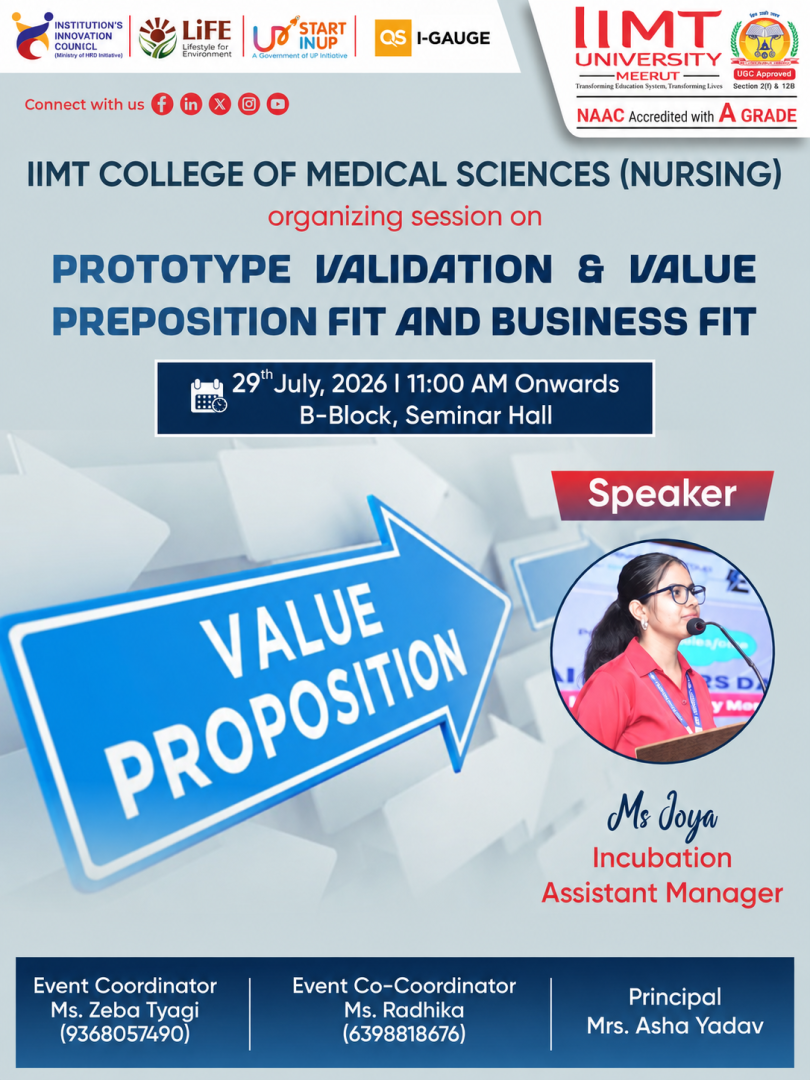
Innovation and entrepreneurship play an important role in transforming creative ideas into practical solutions that address real-world challenges. To encourage an entrepreneurial mindset, develop innovative thinking, and promote startup-oriented learning, IIMT College of Medical Sciences (Nursing), IIMT University, Meerut, organized a specialized session on Prototype Validation, Value Proposition Fit and Business Fit.
The session was scheduled for 29 July 2026 at 11:00 AM onwards at the B-Block Seminar Hall, IIMT University, Meerut. The initiative focused on introducing participants to important concepts of innovation, product development, startup validation, and business model development.
The session was led by Ms. Joya, Incubation Assistant Manager, who provided insights into the importance of validating innovative ideas and understanding the relationship between customer needs, product solutions, and business opportunities.
Understanding Prototype Validation in Innovation and Entrepreneurship
Prototype validation is an essential stage in the innovation and startup development process. It involves evaluating an initial version of a product, service, or solution to determine whether it addresses the intended problem effectively.
An innovative idea may appear promising during its conceptual stage, but its practical value can only be understood when it is tested and evaluated. Prototype validation helps innovators identify potential limitations, understand user expectations, and make necessary improvements before investing significant resources in full-scale development.
During a prototype validation process, entrepreneurs and innovators focus on several important aspects:
- Identifying the actual problem that needs to be addressed.
- Developing an initial prototype or demonstration model.
- Collecting feedback from potential users and stakeholders.
- Evaluating the functionality and practicality of the proposed solution.
- Identifying areas that require improvement.
- Refining the prototype based on feedback and observations.
This approach helps reduce uncertainty and encourages evidence-based decision-making. It also allows innovators to develop solutions that are more relevant, practical, and user-oriented.

What Is Value Proposition Fit?
Value proposition fit refers to the alignment between the solution being developed and the actual needs, expectations, and challenges of its intended customers or users.
A successful innovation should offer meaningful value rather than simply introducing something new. Entrepreneurs must understand who their target users are, what problems they experience, and how their proposed solution can make a positive difference.
A strong value proposition clearly communicates why a customer should choose a particular product or service over existing alternatives.
The important elements of value proposition fit include:
1. Understanding Customer Needs
The first step is identifying the challenges and requirements of potential customers. Understanding users’ expectations helps innovators develop solutions that address genuine problems.
2. Identifying the Target Audience
A product or service should have a clearly defined target audience. Identifying the intended users makes it easier to design appropriate features and communicate the benefits effectively.
3. Defining the Core Value
Innovators must clearly explain the primary benefit of their proposed solution. This may include convenience, affordability, accessibility, improved efficiency, or better service delivery.
4. Gathering User Feedback
Feedback from potential customers helps determine whether the proposed solution meets their expectations. It also provides opportunities to improve the product or service.
5. Improving the Solution
Continuous improvement is necessary to ensure that the innovation remains relevant to customer requirements.
Understanding Business Fit and Its Importance
While value proposition fit focuses on whether a solution meets customer needs, business fit examines whether the proposed solution can operate as a sustainable and viable business.
An innovative product may solve an important problem, but its long-term success also depends on its financial feasibility, operational requirements, market opportunities, and revenue potential.
Business fit helps entrepreneurs evaluate whether their ideas can be converted into sustainable business models.
Some important considerations include:
- Market Demand: Understanding whether sufficient demand exists for the proposed product or service.
- Revenue Model: Identifying how the business will generate income.
- Cost Structure: Evaluating the expenses associated with developing and delivering the solution.
- Market Competition: Understanding existing alternatives and competitors.
- Resource Availability: Identifying the financial, technological, and human resources required.
- Scalability: Evaluating whether the business can expand its operations in the future.
- Long-Term Sustainability: Determining whether the business can maintain its operations and deliver consistent value.
Understanding these factors enables entrepreneurs to make informed decisions and develop practical business strategies.
Difference Between Prototype Validation, Value Proposition Fit and Business Fit
These three concepts are interconnected but address different stages of innovation and entrepreneurship.
Prototype Validation determines whether the proposed solution works as intended and can address the identified problem.
Value Proposition Fit determines whether the solution provides meaningful value to the intended customers.
Business Fit determines whether the solution can be developed, delivered, and maintained through a viable business model.
Together, these concepts provide an important foundation for transforming an innovative idea into a customer-oriented and commercially sustainable venture.
Role of Innovation and Entrepreneurship in Healthcare and Nursing
Innovation has significant potential in healthcare and nursing because the sector continuously requires improved approaches to patient care, healthcare accessibility, service delivery, and operational efficiency.
Students and professionals from medical sciences and nursing can contribute to innovation by identifying practical challenges in healthcare environments and exploring solutions that improve patient experiences.
Potential areas for healthcare innovation include:
- Digital healthcare and telemedicine solutions.
- Patient monitoring and healthcare management systems.
- Medical equipment and assistive technologies.
- Healthcare awareness and education initiatives.
- Affordable and accessible healthcare services.
- Patient safety and infection prevention solutions.
- Innovative approaches to nursing care and hospital management.
Understanding prototype validation and value proposition fit can help aspiring healthcare innovators evaluate their ideas before developing them into practical solutions.
Such learning also encourages students to think beyond conventional academic approaches and explore opportunities for problem-solving, creativity, and entrepreneurship.
Role of IIMT University’s Incubation Ecosystem
An effective incubation ecosystem plays an important role in supporting innovation, entrepreneurship, and startup development.
Through incubation-oriented initiatives, educational institutions can encourage students and aspiring entrepreneurs to identify problems, develop innovative concepts, evaluate market opportunities, and understand the practical requirements of establishing a startup.
The session organized by IIMT College of Medical Sciences (Nursing) reflects the importance of introducing innovation and entrepreneurship concepts across academic disciplines.
By creating awareness about prototype validation, value proposition fit, and business fit, such initiatives can help participants understand the different stages involved in converting an idea into a potential entrepreneurial opportunity.
Session Speaker: Ms. Joya, Incubation Assistant Manager
The session featured Ms. Joya, Incubation Assistant Manager, as the speaker.
Her professional association with the incubation ecosystem provided a relevant perspective on the concepts of prototype validation, value proposition fit, and business fit.
The session highlighted the importance of understanding the practical aspects of innovation and developing solutions that are aligned with user requirements and business opportunities.
Event Coordination and Institutional Support
The session was organized with the coordination and support of the following institutional representatives:
- Event Coordinator: Ms. Zeba Tyagi.
- Event Co-Coordinator: Ms. Radhika.
- Principal: Mrs. Asha Yadav.
Their involvement in the event organization reflects the importance of institutional coordination in facilitating academic and innovation-oriented initiatives.
Importance of Practical Learning and Entrepreneurial Thinking
Entrepreneurship education is most effective when theoretical concepts are connected with practical applications.
Understanding prototype validation, customer requirements, and business feasibility can help students develop an analytical approach towards identifying problems and evaluating possible solutions.
Such sessions can also encourage participants to develop important professional competencies, including:
- Critical and analytical thinking.
- Creative problem-solving.
- Communication and collaboration.
- Customer-oriented thinking.
- Market awareness.
- Innovation management.
- Entrepreneurial decision-making.
These competencies are valuable not only for individuals interested in establishing startups but also for students preparing for professional careers in healthcare, management, technology, and other sectors.
Conclusion
The session on Prototype Validation, Value Proposition Fit and Business Fit, organized by IIMT College of Medical Sciences (Nursing), IIMT University, Meerut, represents an important academic initiative focused on innovation and entrepreneurship awareness.
By introducing participants to the concepts of prototype testing, customer needs assessment, value creation, and business feasibility, the session aimed to strengthen their understanding of the innovation development process.
The contribution of Ms. Joya, Incubation Assistant Manager, along with the coordination of Ms. Zeba Tyagi and Ms. Radhika and the institutional support of Principal Mrs. Asha Yadav, formed part of the event’s organizational framework.
Initiatives focusing on innovation and entrepreneurship can help bridge the gap between academic knowledge and practical problem-solving. They also encourage students to explore new ideas, identify opportunities, and understand how innovative solutions can create value for society.
IIMT University, Meerut, continues to provide an academic environment in which innovation, entrepreneurship awareness, and interdisciplinary learning can be encouraged through such initiatives.