
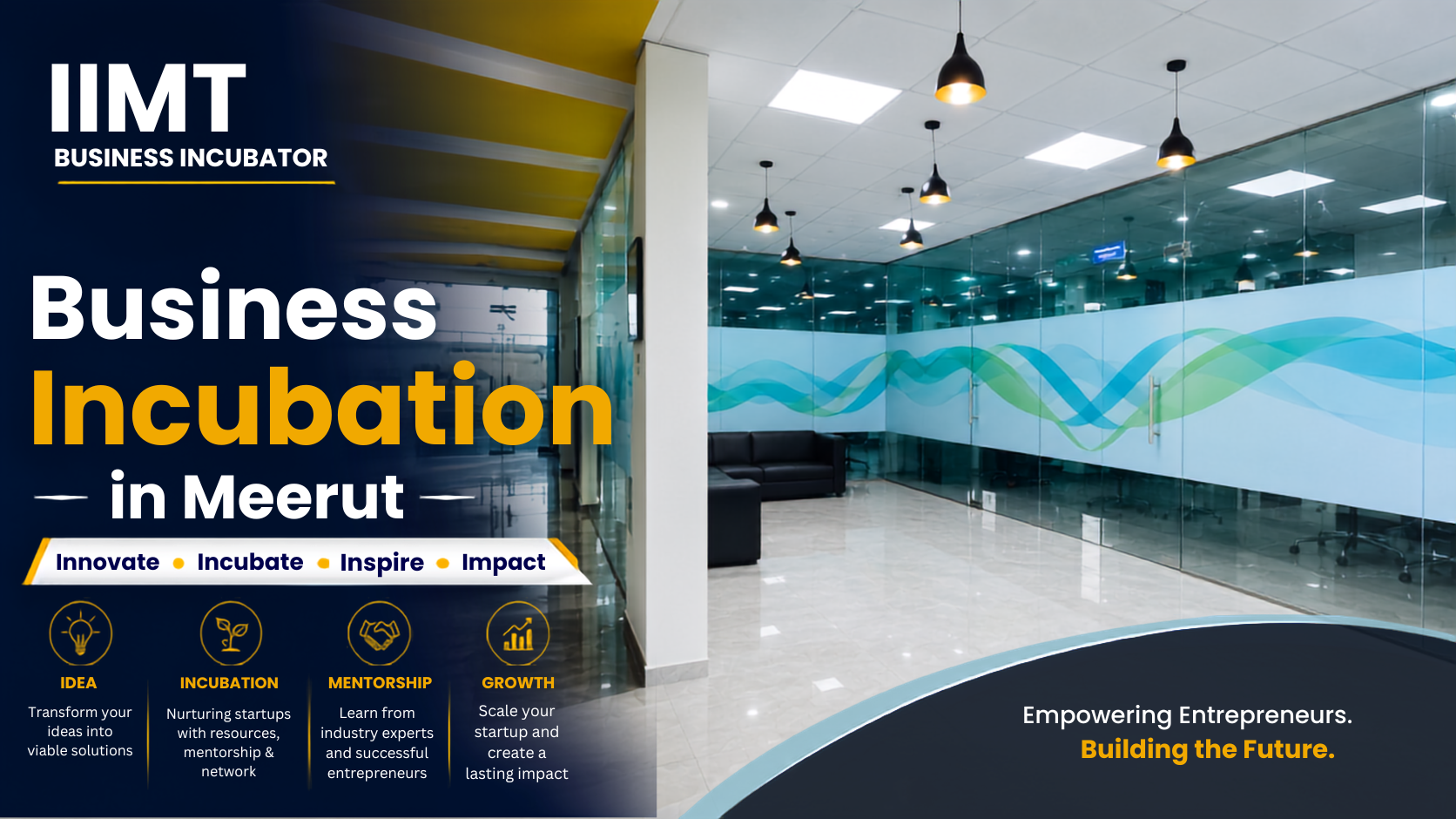
Business Incubation in Meerut: Startup Support at IIMT Business Incubator
Starting a business requires more than a good idea. Entrepreneurs also need guidance, market understanding, practical resources, mentoring, networking, and a clear path from an early concept to a viable business. This is where business incubation can play an important role.
For students, researchers, innovators, and early-stage founders, a business incubator can provide an environment where ideas can be tested, improved, developed, and prepared for the market. In Meerut, the IIMT Business Incubator Foundation (IIMT-BIF) is part of the university’s broader innovation and entrepreneurship ecosystem, supporting aspiring entrepreneurs and startups through incubation-related services and resources.
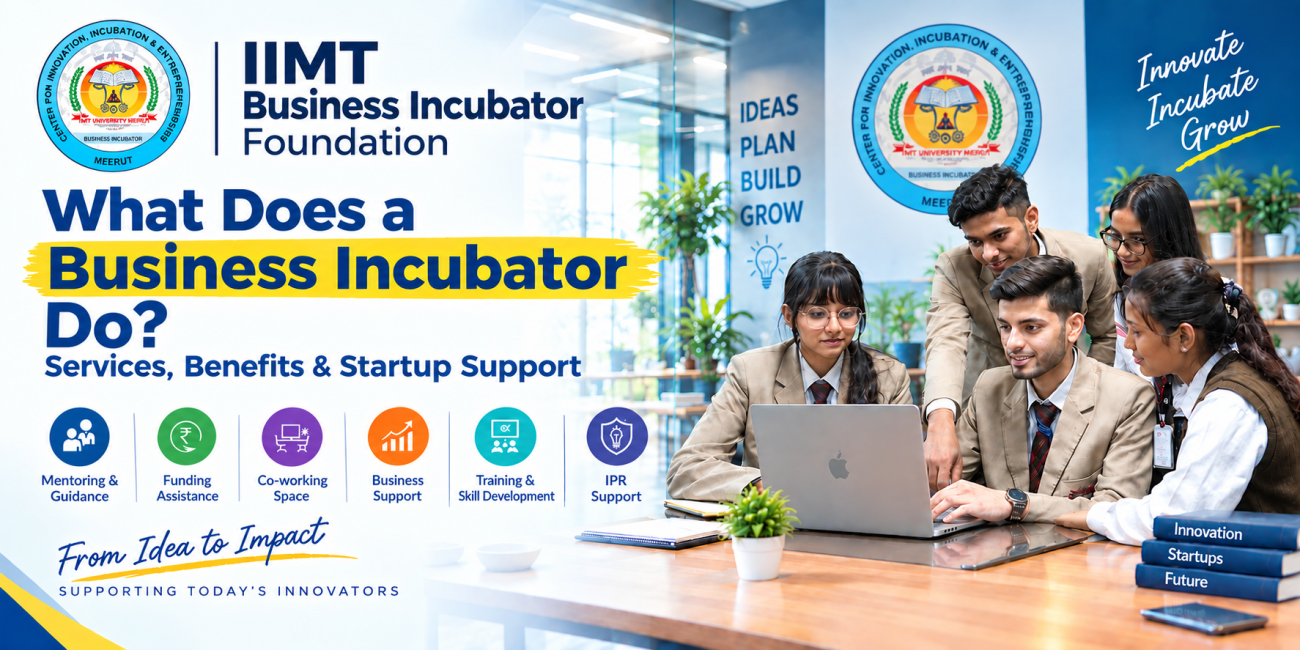
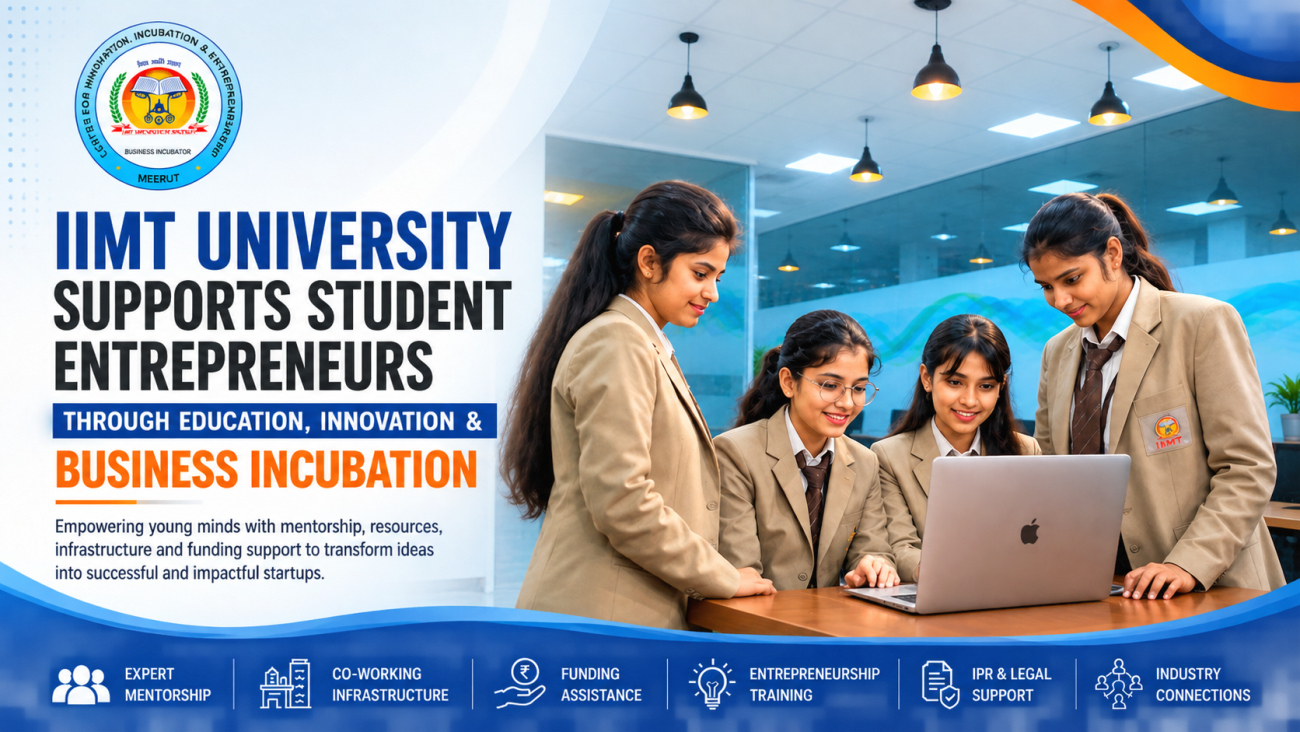
Located at IIMT University in Meerut, Uttar Pradesh, IIMT-BIF provides support areas that include business consulting, mentoring, co-working infrastructure, funding assistance, training and workforce development, and intellectual property rights (IPR) support.
For someone searching for business incubation in Meerut, the important question is not simply where an incubator is located. It is how the incubation ecosystem can help turn an idea into a more structured and market-oriented venture.
What Is Business Incubation?
Business incubation is a structured support process that helps entrepreneurs develop an early-stage business idea into a viable venture.
An incubation ecosystem may provide mentoring, business development support, workspace, training, networking, technical guidance, and assistance with funding readiness. The exact support varies by incubator and startup requirements.
For a student entrepreneur, incubation can provide a bridge between classroom learning and practical entrepreneurship. Instead of trying to solve every startup challenge alone, the founder can access people, resources, knowledge, and networks that may help them make better decisions.
The journey may involve several stages:
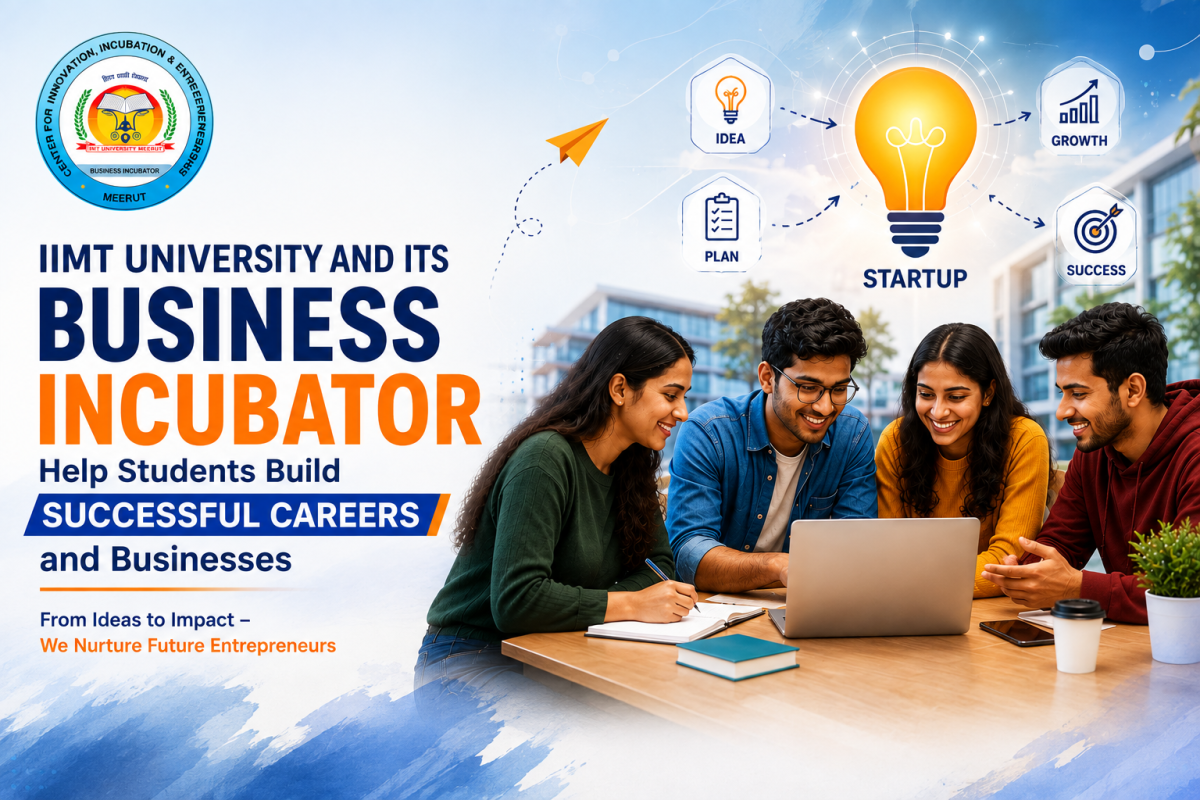
Idea → Validation → Business Model → Mentoring → Prototype/MVP → Market Testing → Funding Readiness → Growth
Business incubation does not guarantee that every startup will succeed. Its value lies in helping founders understand challenges, test assumptions, improve their business approach, and build greater readiness for the next stage.
What Is a Business Incubator?
A business incubator is an organization or ecosystem designed to support early-stage businesses and entrepreneurs.
Unlike a conventional office space, an incubator can combine infrastructure with business support. Depending on the organization, this may include:
- Mentorship
- Business consulting
- Entrepreneurship training
- Networking
- Workspace
- Funding guidance
- Technical support
- Product development support
- IPR guidance
- Connections with investors or industry stakeholders
IIMT-BIF describes its objective as supporting entrepreneurs in shaping business ideas into commercial startup companies. Its official information also states that the organization provides infrastructural support such as office space and meeting rooms, along with mentoring for business ideas.
This makes the incubator relevant to founders who are still developing their business model as well as startups looking for structured support.
Why Business Incubation Matters for Startups
Early-stage founders often face several questions at the same time.
Is the problem worth solving? Who is the customer? How large is the market? What should the product look like? How should the business make money? How can the startup acquire its first customers? When should funding be considered?
A business incubator can help founders approach these questions systematically.
1. Better Business Idea Validation
An idea may sound promising but still lack a clear customer problem or market opportunity.
Validation encourages entrepreneurs to investigate the problem, identify potential users, study competitors, collect feedback, and test whether their assumptions are realistic.
2. Practical Mentoring
Mentoring can help founders look at their startup from different perspectives.
IIMT-BIF maintains an official mentor network and describes its mentoring role as helping early-stage startups and entrepreneurs develop through expert guidance and experience.
3. Business Model Development
A startup needs more than a product. Founders must understand how the venture will create, deliver, and capture value.
Business model development can help entrepreneurs think about customers, channels, revenue, costs, partnerships, and scalability.
4. Access to Infrastructure
Developing a startup can require more than a laptop and an idea. Depending on the venture, founders may need a workspace, meeting facilities, technology resources, or collaborative environments.
IIMT-BIF states that it provides co-working space with office infrastructure, equipment, utilities, and related facilities for startup cohorts.
5. Funding Readiness
Funding is often misunderstood by first-time founders.
Before approaching investors or funding programs, entrepreneurs generally need to understand their business model, market opportunity, product, financial requirements, and growth plan.
IIMT-BIF lists funding assistance among its startup support services.
Business Incubation in Meerut: The Growing Startup Ecosystem
Meerut has an important educational and institutional base, making university-linked entrepreneurship relevant to students and innovators in the region.
A university startup ecosystem can bring together students, faculty, researchers, mentors, entrepreneurs, industry professionals, and other stakeholders.
At IIMT University, entrepreneurship development activities include business plan development workshops, guest lectures, one-to-one mentoring, funding assistance, and networking opportunities. The university encourages aspiring entrepreneurs to participate in incubation sessions and entrepreneurship workshops.
The university’s E-Cell also works with IIMT Business Incubator Foundation to create an environment for budding entrepreneurs through workshops, seminars, and networking activities.
This type of ecosystem is valuable because entrepreneurship becomes connected with learning rather than being treated as a separate activity.
IIMT Business Incubator: Supporting Startup Ideas
The IIMT Business Incubator Foundation is based at IIMT University in Meerut.
According to its official information, the Business Incubation Foundation was established in 2015 and focuses on helping aspiring entrepreneurs develop business ideas into commercial startups. It also provides infrastructural support and mentoring.
IIMT University’s official information describes its incubation ecosystem as supporting research, innovation, incubation, and startups. It also states that pre-incubation and incubation facilities are available on campus in engineering and technology-related areas.
The university’s research and innovation ecosystem further highlights incubation infrastructure for converting research outcomes into viable business models and identifies support for students and faculty through orientation, training, support, and networking.
This combination can be particularly useful when an innovative idea emerges from academic work, a research project, a technical concept, or a student’s entrepreneurial interest.
What Startup Support Does an Incubator Provide?
The support available to a startup depends on its stage, requirements, and the incubator’s programs. At IIMT-BIF, the official services page identifies several areas of support.
Startup Mentoring
Mentoring can help founders understand business decisions, identify potential challenges, develop strategies, and improve leadership capabilities.
IIMT-BIF’s services specifically include mentoring support, including assistance related to talent, investors, company valuation, and company culture.
Business Support and Consulting
Business consulting can help entrepreneurs address practical business challenges while developing and scaling a venture.
IIMT-BIF states that its business support and consulting service is intended to assist entrepreneurs and businesses with starting, scaling, and succeeding.
Entrepreneurship Training
Training helps founders build capabilities beyond their technical idea.
Entrepreneurship education may cover business planning, market understanding, communication, leadership, financial thinking, pitching, and other practical skills.
Networking Opportunities
A startup rarely develops in isolation.
Networking can introduce entrepreneurs to mentors, industry professionals, investors, other founders, and potential collaborators.
IIMT University’s entrepreneurship development information specifically includes networking with industry leaders as one of its support areas.
Funding Assistance
Funding may become important when a startup is ready to develop its product, test the market, expand operations, or pursue growth.
IIMT-BIF lists funding assistance among its services and states that it helps startups seek initial support during their early stage.
Funding should not be viewed as the starting point for every startup. Strong problem validation, a credible business model, and evidence of market demand can be important before pursuing external capital.
Co-Working Infrastructure
IIMT-BIF provides co-working facilities for startup cohorts, including office infrastructure, equipment, and utilities.
For early-stage founders, having a professional working environment can support collaboration and focused execution.
IPR Support
Intellectual property can be important for startups developing original technology, brands, creative assets, or other protectable intellectual assets.
IIMT-BIF identifies IPR services covering areas such as patent and trademark support and copyright protection.
Training and Workforce Development
Startup founders eventually need teams capable of executing the business plan.
IIMT-BIF’s services include training and workforce development, with an emphasis on connecting students with real-world learning experiences.
Who Can Benefit From Business Incubation at IIMT?
Business incubation is not limited to experienced entrepreneurs.
The IIMT ecosystem can be relevant to several groups.
Students
Students can explore entrepreneurship while continuing their academic journey. A business idea developed as part of a project, competition, research activity, or personal interest can potentially become the starting point for a venture.
Student Entrepreneurs
Student founders often need help understanding business fundamentals that are not covered by technical education alone.
Mentoring, workshops, networking, and business development support can help them build entrepreneurial capabilities.
Early-Stage Founders
Founders who have already started working on an idea may benefit from structured support as they refine their business model, product, market strategy, and growth plans.
Innovators and Researchers
Research can generate technologies and solutions with commercial potential.
IIMT University’s research and innovation ecosystem specifically discusses the role of incubation infrastructure in converting research outcomes into viable business models.
Aspiring Entrepreneurs
You do not necessarily need to begin with a fully developed company.
Entrepreneurs can use incubation environments to learn about business development and understand what is required to move an idea toward implementation.
How Business Incubation Helps Turn an Idea Into a Startup
A practical incubation journey can be understood through several stages.
Step 1: Identify the Problem
Start with a real problem.
A strong startup idea should answer a basic question: Whose problem are you solving, and why does it matter?
Step 2: Validate the Idea
Talk to potential users. Research existing solutions. Examine competitors. Identify what is different about your approach.
Validation can reveal whether the original idea needs to change.
Step 3: Develop the Business Model
Determine how the venture will create value and generate revenue.
At this stage, entrepreneurs should consider customers, pricing, costs, distribution, resources, and partnerships.
Step 4: Seek Mentoring
Experienced mentors can provide an outside perspective.
A founder may understand the technology well but need additional guidance on marketing, finance, customer acquisition, operations, or leadership.
Step 5: Build a Prototype or MVP
The next objective is often to develop a practical version of the solution.
An MVP—minimum viable product—allows entrepreneurs to test the core value proposition without investing unnecessarily in every possible feature.
Step 6: Test the Market
Market testing provides evidence.
Customer feedback can reveal what works, what needs improvement, and whether customers are willing to use or pay for the solution.
Step 7: Prepare for Funding
Once the startup has stronger evidence and a clearer business model, founders can consider appropriate funding options.
Pitch decks, financial projections, market analysis, and growth plans become important at this stage.
Step 8: Focus on Growth
After establishing product-market evidence, startups can work on improving operations, customer acquisition, team building, partnerships, and expansion.
The incubation journey is therefore not simply about having a place to work. It is about progressively reducing uncertainty and improving the startup’s readiness.
Why Choose a Business Incubator in Meerut?
For entrepreneurs in Meerut and nearby areas, a local incubation ecosystem can offer practical advantages.
Access to a University Ecosystem
A university can bring together academic knowledge, students, faculty, research, laboratories, events, and industry-oriented learning.
IIMT University connects its entrepreneurship and incubation activities with the broader academic environment.
Mentors and Experts
Founders can benefit from experienced people who understand different aspects of business development.
IIMT-BIF maintains a dedicated mentor network covering professionals from different backgrounds.
Student Innovation
Universities provide a large pool of students working on technical, business, scientific, and creative ideas.
This creates opportunities for student-led entrepreneurship and interdisciplinary collaboration.
Industry Exposure
Entrepreneurship becomes stronger when students and founders interact with people outside the classroom.
Workshops, networking events, mentoring sessions, and startup-focused activities can provide exposure to practical business challenges.
Local Accessibility
For entrepreneurs based in Meerut, having an incubation centre within the city can make participation in mentoring, events, networking, and other activities more practical.
IIMT-BIF lists its office at B Block, IIMT University, Meerut, Uttar Pradesh.
IIMT Business Incubator and Entrepreneurship Development
Entrepreneurship development is about more than launching companies. It is also about developing the skills and mindset required to identify opportunities, solve problems, communicate ideas, manage uncertainty, and create value.
IIMT University’s entrepreneurship development initiative identifies business plan workshops, entrepreneur lectures, one-to-one mentoring, funding assistance, and networking as part of its entrepreneurship support.
The university’s E-Cell and IIMT Business Incubator Foundation also work together to support budding entrepreneurs through entrepreneurship-focused activities.
This university-linked model can connect:
Education → Research → Innovation → Mentoring → Incubation → Market Readiness
That connection is especially useful for students who want to explore entrepreneurship without separating it completely from their academic environment.
Business Incubation for Students and Young Entrepreneurs
For students, the biggest barrier to entrepreneurship is not always funding. Often, it is a lack of practical knowledge.
A student may have a technology idea but not know how to validate the market. Another may understand the customer problem but not know how to build a business model. Someone else may have a working prototype but need help preparing for customers or investors.
This is where an incubation ecosystem can add value.
Students can develop skills in:
- Problem identification
- Customer research
- Business planning
- Product development
- Market validation
- Communication
- Pitching
- Networking
- Leadership
- Entrepreneurial decision-making
IIMT-BIF’s official program information has specifically included early-stage startups and student innovators among its intended participants, with a 12-week incubation program designed around mentorship, strategic guidance, and access to capital.
For a young entrepreneur in Meerut, the opportunity is therefore not simply to start a company. It is to learn how entrepreneurship works through practical experience.
From Classroom Project to Startup
One of the strongest opportunities in a university ecosystem is the possibility of taking an academic idea beyond the classroom.
For example, a student project could identify a problem in healthcare, agriculture, education, technology, sustainability, or another sector.
The next questions could be:
- Does the problem affect enough users?
- What solutions already exist?
- What makes this idea different?
- Can a prototype be developed?
- Who would use it?
- How could the venture generate revenue?
- What resources are required?
- Is intellectual property protection relevant?
- What feedback does the market provide?
An incubator can provide an environment in which these questions are explored more systematically.
How to Get Started With Business Incubation at IIMT
The best approach is to begin with the official IIMT Business Incubator resources rather than assuming that every startup follows the same process.
IIMT-BIF provides information about its programs, services, mentors, startups, and relevant resources on its official website. Its website also provides a contact route for questions and lists its Meerut location.
A practical starting approach is:
1. Clarify your idea
Write down the problem, proposed solution, target users, and current stage.
2. Review the incubation ecosystem
Explore the official IIMT-BIF information about services, programs, mentors, and incubation opportunities.
3. Prepare your basic startup information
Be ready to explain the problem, solution, target market, team, current progress, and what support you need.
4. Explore the current program or contact process
Program availability and application requirements can change, so use the current official IIMT-BIF information rather than relying on outdated procedures.
5. Discuss your requirements
If you are unsure whether your idea is suitable, contact the incubator and explain your stage and requirements.
The official IIMT-BIF contact page lists its office at IIMT University, Meerut, along with contact details for enquiries.
What Makes a Startup Ready for Incubation?
There is no single formula for a good startup idea, but founders should try to demonstrate clarity.
Before approaching an incubator, consider preparing:
- A clear problem statement
- Proposed solution
- Target customer
- Market research
- Competitor analysis
- Current prototype or MVP, if available
- Business model
- Founding team information
- Current progress
- Key challenges
- Support required
You do not need to have every answer before seeking guidance. In fact, one purpose of incubation is to help entrepreneurs improve areas that are still unclear.
Business Incubator vs Accelerator: What Is the Difference?
A business incubator generally supports entrepreneurs while they are developing and validating an early-stage idea or venture.
An accelerator usually works with startups that have already reached a certain level of development and aims to help them grow more quickly through a structured, time-bound program.
The distinction is not absolute because programs can overlap. Some incubation ecosystems may also run accelerator-style initiatives.
The important point is to choose support based on your startup’s stage rather than focusing only on the program’s name.
Building a Strong Startup Ecosystem in Meerut
A healthy startup ecosystem depends on collaboration.
Students need opportunities to experiment. Researchers need pathways to commercialize useful ideas. Founders need mentors. Investors need promising ventures. Industry needs innovation. Universities can help connect many of these participants.
IIMT-BIF’s ecosystem includes mentors, startups, collaborations, entrepreneurship initiatives, and university-linked activities. Its official website also publishes information about its incubated startups and collaborations.
This kind of ecosystem can contribute to entrepreneurship development in Meerut by creating more opportunities for people to move from ideas toward practical business activity.
Frequently Asked Questions
What is business incubation?
Business incubation is a structured support process that helps early-stage entrepreneurs develop ideas and businesses through resources such as mentoring, training, infrastructure, networking, and business guidance.
What is a business incubator in Meerut?
A business incubator in Meerut is an organization or ecosystem that supports entrepreneurs and startups in the region. IIMT Business Incubator Foundation operates from the IIMT University campus in Meerut and provides incubation-related services including mentoring, business support, workspace, funding assistance, training, and IPR support.
What does a startup incubator do?
A startup incubator helps entrepreneurs develop and strengthen their ventures. Support can include mentoring, business planning, infrastructure, networking, training, funding guidance, and other startup development resources.
Can students join a business incubator?
Yes. Student innovators and student-led ventures can be suitable for incubation. IIMT-BIF’s official program information specifically identifies student innovators among its intended participants.
How can a business incubator help startups?
An incubator can help startups address challenges related to business models, market validation, mentoring, infrastructure, product development, funding readiness, networking, and intellectual property.
How does startup mentoring work?
Startup mentoring connects entrepreneurs with experienced professionals who can provide guidance based on the startup’s needs. Mentoring may cover strategy, market readiness, leadership, business development, funding, or other areas.
What is the difference between an incubator and an accelerator?
An incubator generally focuses on helping early-stage ideas and ventures develop, while an accelerator generally focuses on helping more developed startups grow within a structured program. However, the exact model varies between organizations.
Why should startups choose a business incubator in Meerut?
A Meerut-based incubator can provide local access to mentoring, entrepreneurship activities, university resources, networking, and startup support. A university-linked environment can also connect founders with students, researchers, faculty, and academic resources.
How can I get startup support in Meerut?
Start by identifying an appropriate incubator and reviewing its current programs and services. For IIMT-BIF, entrepreneurs can explore the official website’s program, services, mentor, and contact information before approaching the organization.
What support can entrepreneurs receive from an incubator?
Support varies by program, but IIMT-BIF officially lists business consulting, co-working spaces, mentoring, funding assistance, training and workforce development, and IPR support.
Do I need a fully developed startup before approaching an incubator?
Not necessarily. Incubation can support early-stage ideas as well as startups that have already begun development. The appropriate program depends on the venture’s stage and the incubator’s current criteria.
Final Thoughts
Business incubation can provide an important bridge between an entrepreneurial idea and the practical work required to develop a startup.
In Meerut, the IIMT Business Incubator Foundation forms part of IIMT University’s wider innovation and entrepreneurship ecosystem. Its official services include mentoring, business support and consulting, co-working infrastructure, funding assistance, training, and IPR support.
If you are a student, aspiring entrepreneur, researcher, innovator, or early-stage founder with an idea worth exploring, the next step is to understand your current startup stage and identify the support you need.
Explore the official IIMT Business Incubator Foundation resources to learn more about current incubation programs, services, mentors, and opportunities for entrepreneurship development in Meerut.


One thought on “Business Incubation in Meerut | IIMT Business Incubator”