
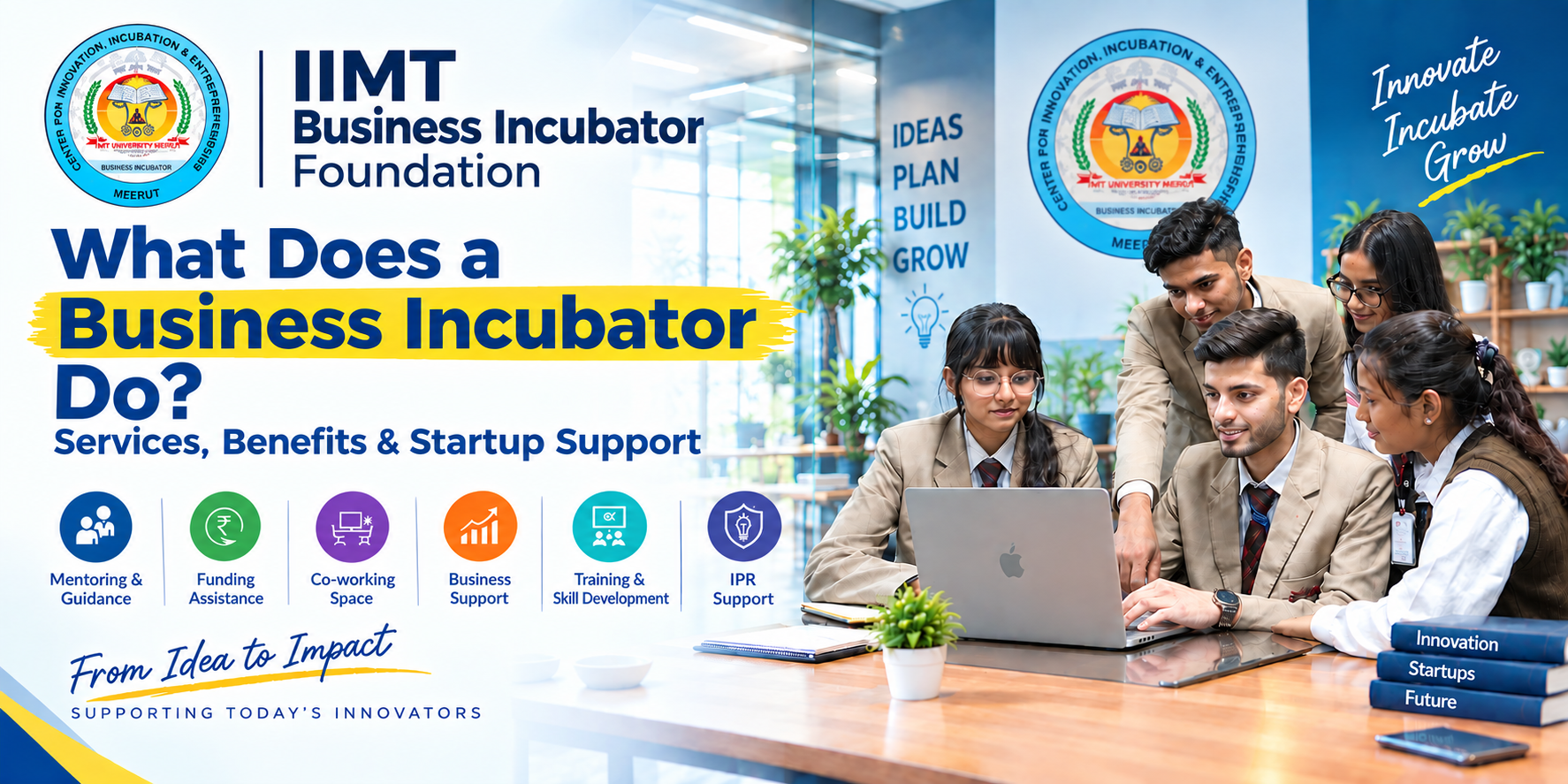
What Does a Business Incubator Do? Services, Benefits & Startup Support
Starting a business involves much more than having a good idea. Entrepreneurs need to understand their customers, validate a problem, develop a business model, build products or services, manage resources, and prepare for the market. For many first-time founders, navigating these challenges alone can be difficult.
A business incubator provides structured support to help entrepreneurs move from an early-stage idea toward a more developed and market-ready venture. Depending on its model, an incubator may provide mentoring, business consulting, co-working infrastructure, training, networking, funding assistance, and intellectual property support.
For students, researchers, innovators, and early-stage founders, incubation can provide an environment where ideas can be tested, refined, and developed with access to relevant expertise and resources.
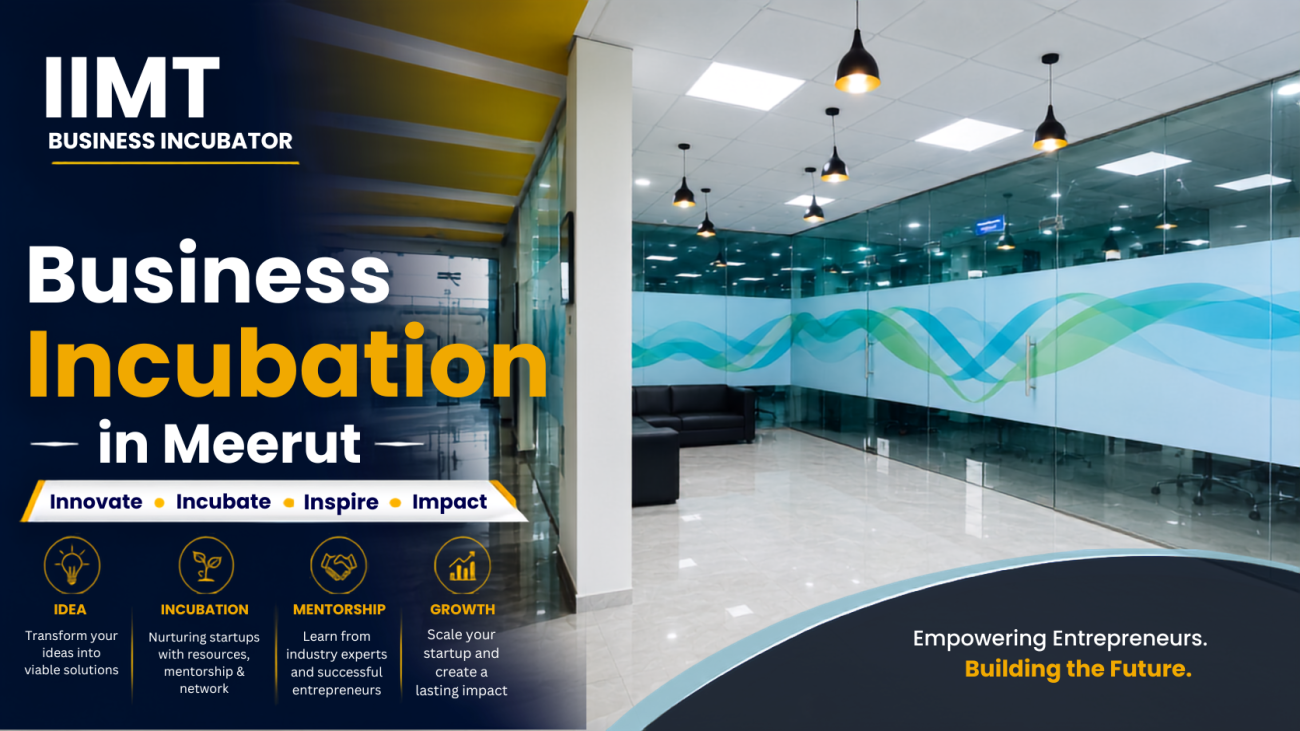
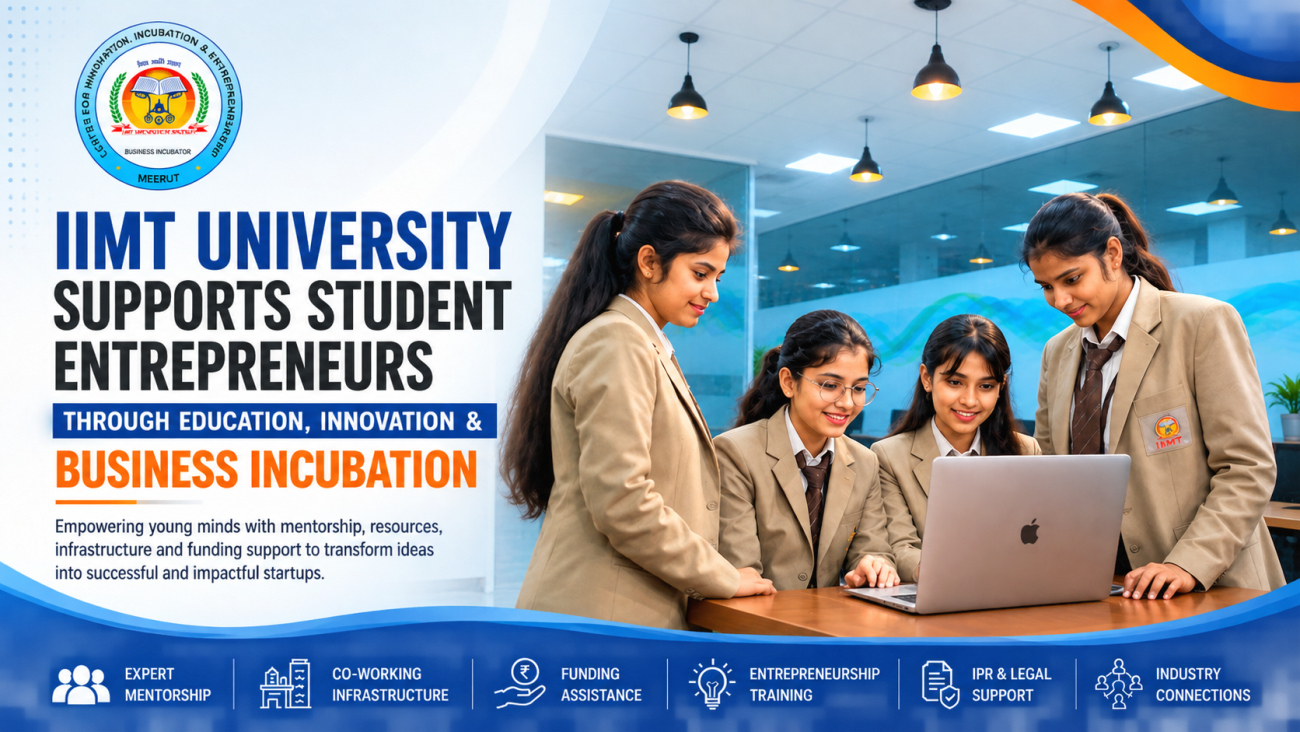
The IIMT Business Incubator Foundation (IIMT-BIF) is part of the IIMT University innovation and entrepreneurship ecosystem in Meerut. Its official services include business support and consulting, co-working spaces, mentoring support, funding assistance, training and workforce development, and IPR support.
This guide explains what a business incubator foundation does, the services it can provide, how incubation works, who can benefit, and how entrepreneurs can evaluate an incubator before applying.
What Is a Business Incubator?
A business incubator foundation is an organization or structured support ecosystem that helps entrepreneurs and early-stage businesses develop their ideas, capabilities, products, and business models.
The objective is not simply to provide office space. Effective incubation can combine business guidance, mentoring, infrastructure, training, networking, funding assistance, and other startup resources according to the needs of the entrepreneur.
The Government of India’s startup-incubation resources describe incubators as organizations that may provide combinations of office or co-working space, business services, coaching and mentoring, funding access, and networks. The exact combination varies between incubators.
At IIMT-BIF, the official website describes the foundation as a Section 8 non-profit entity focused on research, innovation, incubation, and startups, with on-campus pre-incubation and incubation facilities.
What Is Business Incubation?
Business incubation is a structured process that helps entrepreneurs develop a business from an early stage.
A typical incubation journey may involve:
- Understanding and defining a problem
- Developing an initial business idea
- Conducting market research
- Validating customer needs
- Developing a business model
- Building a product or service
- Receiving expert mentoring
- Preparing for market entry
- Developing funding readiness
- Building professional and industry connections
The process is not identical for every startup. A technology startup with a prototype may need product-development and IPR guidance, while a student with only an idea may first need market validation and business-model support.
Who Can Join a Business Incubator?
Business incubators can support different types of entrepreneurs, depending on their eligibility criteria and programs.
Potential participants may include:
- Students with startup ideas
- Student entrepreneurs
- Aspiring entrepreneurs
- Early-stage founders
- Researchers
- Innovators
- Technology-based startups
- Startup teams
- MSMEs
- Entrepreneurs developing new products or services
IIMT-BIF’s published program information has specifically included early-stage startups and student innovators among its intended participants.
Why Do Early-Stage Startups Need Incubation Support?
Early-stage founders often have limited experience in areas such as customer discovery, pricing, business planning, investor communication, intellectual property, hiring, and market positioning.
An incubator can provide access to people, infrastructure, knowledge, and networks that may otherwise take significant time to build independently.
The value of incubation therefore comes from bringing relevant support together around the entrepreneur rather than expecting the founder to solve every business challenge alone.
What Does a Business Incubator Foundation Do?
A business incubator foundation can support a startup at several stages, from idea development to market preparation and growth.
The exact services depend on the incubator, but the major areas commonly include the following.
Provides Startup Mentoring and Guidance
Mentoring is one of the most important components of incubation.
A founder may need guidance on business models, customer discovery, product development, hiring, investor readiness, company structure, or market strategy.
IIMT-BIF’s official services page describes mentoring support that can help entrepreneurs with areas such as talent, investors, company valuation, and company culture.
The goal of mentoring is not to make decisions for the founder. Instead, good mentors help entrepreneurs ask better questions, identify risks, evaluate alternatives, and make more informed decisions.
Offers Business Support and Consulting
A promising idea still needs a practical business structure.
Business consulting may help entrepreneurs understand:
- Target customers
- Business models
- Market opportunities
- Competitor positioning
- Business planning
- Operational challenges
- Compliance-related considerations
- Growth priorities
IIMT-BIF lists business support and consulting among its core services and describes its support as relevant to entrepreneurs and businesses at different stages.
Helps Entrepreneurs Develop Business Ideas
Not every idea is ready to become a startup.
Incubation can help founders examine whether a proposed solution addresses a genuine problem and whether customers may be willing to use or pay for it.
This can involve:
- Defining the problem
- Identifying the target customer
- Researching the market
- Studying competitors
- Testing assumptions
- Refining the solution
- Developing a business model
This process helps entrepreneurs move from an idea-driven approach toward evidence-based business development.
Provides Co-Working and Infrastructure Support
Infrastructure can be particularly useful for founders who do not yet have a dedicated workplace.
IIMT-BIF lists co-working spaces with office infrastructure, equipment, utilities, and facilities for startup cohorts.
Depending on the startup’s requirements, an appropriate incubation environment can make it easier to collaborate with mentors, team members, researchers, and other entrepreneurs.
Supports Funding and Investor Connections
Funding is important, but an incubator does not necessarily mean guaranteed investment.
Incubation support can help entrepreneurs understand funding options, improve their business presentation, prepare for investor discussions, and explore relevant funding opportunities.
IIMT-BIF lists funding assistance among its services. Its published incubation-program information has also described access to capital and potential funding through relevant schemes as part of a program structure.
Entrepreneurs should always check the current program terms and eligibility requirements because funding availability and application processes can change.
Provides Training and Skill Development
Founders need more than technical skills.
They may also need capabilities in:
- Business planning
- Leadership
- Communication
- Pitching
- Financial understanding
- Marketing
- Product development
- Team management
- Entrepreneurial decision-making
IIMT-BIF provides training and workforce development support and describes opportunities to connect students with real-world learning experiences.
Helps With Intellectual Property Rights (IPR)
For innovation-driven startups, intellectual property can be an important business consideration.
Depending on the innovation, founders may need to understand patents, trademarks, copyrights, or other forms of intellectual property protection.
IIMT-BIF specifically lists IPR support covering areas such as patent and trademark support and copyright protection.
Founders should still obtain appropriate professional or legal advice for specific intellectual-property decisions.
Builds Industry and Startup Networking Opportunities
Entrepreneurship rarely happens in isolation.
Connections with mentors, industry professionals, investors, researchers, service providers, and other founders can help entrepreneurs discover new perspectives and opportunities.
Government incubation guidance also recognizes networks and linkages as an important component of incubation support.
Key Services Offered by a Business Incubator Foundation
The following services represent the major areas entrepreneurs should evaluate when choosing an incubation centre.
Business Consulting
Business consulting helps founders understand commercial challenges and make better-informed decisions about their venture.
Startup Mentorship
Mentorship gives founders access to experienced professionals or subject-matter experts who can provide guidance based on their startup stage and requirements.
Co-Working Spaces
Co-working infrastructure provides an environment for founders and teams to work, collaborate, and access basic startup facilities.
Funding Assistance
Funding assistance can help entrepreneurs understand funding routes and improve their readiness for potential financial support.
However, entrepreneurs should distinguish funding assistance from a guarantee of investment.
Training and Workforce Development
Training develops the entrepreneurial, managerial, technical, and professional skills required to operate a growing business.
IPR Support
IPR support can help founders understand and protect valuable intellectual assets such as inventions, brands, and original works.
Networking and Industry Connections
Networking can introduce entrepreneurs to potential mentors, collaborators, customers, investors, and industry stakeholders.
Startup Development Support
The overall objective of incubation is to help entrepreneurs progress from an early-stage concept toward a more structured and market-ready business.
Benefits of Joining a Business Incubator
Joining a suitable incubator can provide several practical advantages.
Expert Guidance
Instead of making every decision independently, founders can seek input from mentors and professionals who understand common startup challenges.
Reduced Early-Stage Business Challenges
Incubation cannot eliminate business risk, but structured support can help founders identify problems earlier and approach important decisions more systematically.
Access to Infrastructure and Resources
Co-working facilities, equipment, workspace, and other resources can reduce some of the practical barriers faced by early-stage teams.
Funding and Investor Opportunities
Incubators may help entrepreneurs become better prepared for funding conversations and connect them with relevant ecosystem opportunities.
Networking and Collaboration
A startup ecosystem creates opportunities to interact with other entrepreneurs, mentors, professionals, institutions, and potential partners.
Skill and Entrepreneurial Development
Training and workshops can help founders develop the business and leadership capabilities needed to manage a growing venture.
Support for Innovation and Product Development
Incubation can help entrepreneurs move from an initial concept toward product development, testing, validation, and market preparation.
Intellectual Property Protection
IPR guidance can help innovative businesses understand how intellectual assets can be protected and managed.
How Does a Business Incubator Help Startups Grow?
The incubation journey can be understood as a sequence of development stages.
1. Idea Development
The entrepreneur defines the problem, proposed solution, target users, and initial opportunity.
2. Validation
The founder tests whether the problem exists and whether the proposed solution is relevant to potential customers.
3. Business Model Development
The startup identifies how it will create, deliver, and capture value.
4. Mentoring
Mentors help the founder identify gaps, evaluate decisions, and improve the business strategy.
5. Product or Service Development
The team develops and improves its product, service, prototype, or minimum viable product.
6. Market Preparation
The startup studies customers, competitors, pricing, positioning, distribution, and market-entry requirements.
7. Funding Readiness
The founder prepares business information, financial assumptions, pitch material, and other requirements relevant to potential funding opportunities.
8. Networking
The startup develops relationships with mentors, industry professionals, investors, partners, and other ecosystem participants.
9. Launch
Once sufficiently prepared, the startup introduces its product or service to the target market.
10. Growth and Scaling
After gaining market experience, the startup can work on improving operations, customer acquisition, revenue, team capability, and expansion.
This journey is not always linear. Startups often return to earlier stages after receiving customer feedback or discovering new market information.
Business Incubator vs Accelerator: What Is the Difference?
Incubators and accelerators both support startups, but their typical focus can differ.
| Factor | Business Incubator | Accelerator |
|---|---|---|
| Main purpose | Develop and strengthen early-stage ventures | Accelerate growth of existing startups |
| Startup stage | Idea, pre-incubation, early stage | Usually startups with a defined product or business |
| Duration | Can be flexible or longer-term | Often structured around a fixed program |
| Mentorship | Development-focused guidance | Growth and execution-focused guidance |
| Funding | May provide or facilitate funding assistance | May include investment or funding opportunities |
| Business development | Business-model and product development | Market expansion and growth |
| Growth focus | Building a strong foundation | Faster scaling and traction |
These are general distinctions, not universal rules. Some incubators and accelerators use overlapping models.
Who Should Join a Business Incubator?
A business incubator may be useful for people who have an idea or early-stage venture but need structured support.
Students
Students can use incubation to turn academic ideas, projects, or innovations into potential ventures.
Aspiring Entrepreneurs
People who want to start a business but need guidance on validation, planning, and execution can benefit from an incubation ecosystem.
Early-Stage Startups
Startups that are still developing their product, market, team, or business model may need structured support before focusing heavily on scaling.
Researchers
Researchers can explore how research-based ideas may be developed into products, services, or commercial ventures.
Innovators
Innovators developing new technologies or solutions may require product-development, business, networking, and IPR support.
Student Founders
Student-led ventures can benefit from combining academic resources with entrepreneurship development.
MSMEs
Small businesses may seek business consulting, workforce development, networking, and innovation-related support.
Technology-Based Startups
Technology startups may require specialist mentoring, infrastructure, IPR guidance, product-development support, and market connections.
Business Incubation in Meerut: Startup Support at IIMT Business Incubator Foundation
For entrepreneurs searching for a business incubator in Meerut, the IIMT Business Incubator Foundation is part of the IIMT University innovation and entrepreneurship ecosystem.
IIMT-BIF’s official website describes the foundation as a Section 8 non-profit entity focused on research, innovation, incubation, and startups. It provides on-campus pre-incubation and incubation facilities and works with students and aspiring entrepreneurs.
Its current services include:
- Business support and consulting
- Co-working spaces
- Mentoring support
- Funding assistance
- Training and workforce development
- IPR support
This makes IIMT-BIF relevant to students, innovators, aspiring founders, and early-stage entrepreneurs looking for business incubation Foundation in Meerut.
The foundation’s published program information has also included early-stage startups and student innovators and described support such as 1:1 mentorship, workshops, startup resources, pitch training, workspace, and incubation support.
For the most accurate eligibility and application information, entrepreneurs should check the current program details or contact IIMT-BIF directly because programs and requirements may change.
Why Choose IIMT Business Incubator Foundation for Startup Support?
Choosing an incubator should be based on the actual support available and its relevance to your startup stage.
IIMT-BIF provides a university-linked environment for entrepreneurship, research, innovation, and startup development. Its official website identifies pre-incubation and incubation facilities, experienced faculty mentoring, infrastructure support, and entrepreneurship programs.
Its service offering adds several practical components:
Mentorship: Guidance from experienced professionals and mentors.
Startup ecosystem: An environment connected with university-based innovation and entrepreneurship.
Infrastructure: Co-working and other incubation facilities.
Funding assistance: Support related to early-stage funding opportunities.
Training: Programs and learning opportunities for entrepreneurship and workforce development.
Networking: Connections within the startup and business ecosystem.
IPR support: Assistance related to patents, trademarks, and copyright protection.
For entrepreneurs in Meerut, the university-linked environment can be particularly relevant when the founder wants to combine learning, innovation, research, and entrepreneurship.
How to Choose the Right Business Incubator for Your Startup
Not every incubator is suitable for every startup. Before applying, compare the support offered with your actual needs.
Check the Incubator’s Services
Make a list of the services you require.
For example, a founder with only an idea may prioritize mentoring and validation, while a startup with a prototype may need product development, IPR, funding readiness, and market access.
Evaluate Mentorship and Expertise
Look at the mentors, their experience, and whether their expertise matches your industry or business challenge.
Check Infrastructure and Resources
Understand what workspace, equipment, technology, laboratories, meeting facilities, or other resources are actually available.
Understand Funding Support
Ask whether the incubator provides funding, facilitates connections, supports applications, or simply provides funding guidance.
Do not assume that joining an incubator guarantees investment.
Review Networking Opportunities
A strong network can be valuable for founders seeking customers, mentors, partners, investors, or industry expertise.
Check Industry and Academic Connections
For research- or technology-driven startups, links with universities, laboratories, industries, and subject experts can be particularly useful.
Understand Eligibility and Application Requirements
Review the current application process, startup stage requirements, program duration, costs, selection process, and other conditions before applying.
Frequently Asked Questions About Business Incubators
What is a business incubator foundation?
A business incubator foundation is an organization that provides structured support to help entrepreneurs and early-stage businesses develop their ideas, products, business models, skills, and market readiness.
What services does a business incubator provide?
Common services include mentoring, business consulting, co-working infrastructure, training, networking, funding assistance, product-development support, and IPR guidance. The exact services vary by incubator.
What are the benefits of joining a business incubator?
Benefits can include access to mentors, infrastructure, business guidance, training, networking, funding opportunities, and startup resources.
Do business incubators provide funding?
Some incubators provide funding or funding assistance, while others connect startups with external funding sources. Funding is not automatically guaranteed. IIMT-BIF lists funding assistance as one of its services.
Can students join a business incubator?
Yes, some incubators accept students and student-led ventures. IIMT-BIF’s published program information specifically includes student innovators among its intended participants.
How does startup incubation work?
Startup incubation generally involves idea development, validation, business-model development, mentoring, product development, market preparation, funding readiness, networking, launch, and growth.
What is the difference between an incubator and an accelerator?
An incubator generally focuses on developing early-stage ideas and businesses, while an accelerator typically focuses on helping more developed startups grow faster through a structured program. Models vary between organizations.
How can I find a startup incubator in Meerut?
Entrepreneurs can compare incubators based on services, mentoring, infrastructure, industry connections, funding assistance, eligibility, and application requirements. IIMT-BIF operates within the IIMT University campus in Meerut and provides incubation-related services.
What support does IIMT Business Incubator Foundation provide?
IIMT-BIF lists business support and consulting, co-working spaces, mentoring support, funding assistance, training and workforce development, and IPR support among its services.
How can entrepreneurs apply for incubation support?
Application procedures can depend on the current program. Entrepreneurs should review the latest IIMT-BIF program information and contact the foundation for current eligibility and application requirements. The official contact page lists its Meerut office and enquiry details.
Conclusion
A business incubator foundation can provide much more than a physical workspace. For early-stage entrepreneurs, it can bring together mentoring, business consulting, infrastructure, training, networking, funding assistance, and intellectual property support.
The most valuable aspect of incubation is the structured environment it creates around the entrepreneur. Instead of developing an idea without guidance, founders can test assumptions, learn from mentors, improve their business models, develop products, prepare for the market, and build connections.
For students, researchers, innovators, and early-stage founders in Meerut, IIMT Business Incubator Foundation offers a university-linked incubation environment with services covering business support, mentoring, co-working, funding assistance, training, and IPR support.
If you have a startup idea or are already developing an early-stage venture, the next step is to identify your current stage, understand the support you need, and review the incubator’s current programs and eligibility requirements.
Explore the official IIMT-BIF resources to learn more about business incubation Foundation in Meerut, available services, programs, and startup-support opportunities.