
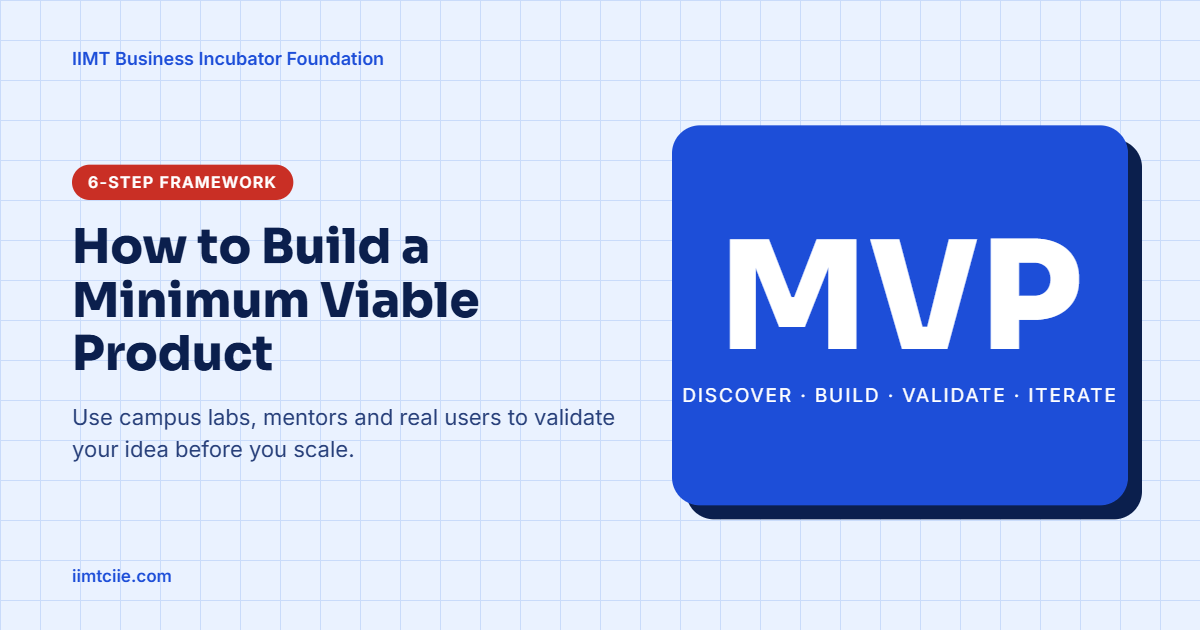
How to Build a Minimum Viable Product (MVP) within a University Incubator: A Practical Framework for Student Founders
For many student founders in 2026, the transition from a classroom idea to a market-ready business is often hindered by the “perfection trap.” Many aspiring entrepreneurs spend months developing complex features that users may never use, exhausting their limited capital and energy. This is where the concept of Minimum Viable Product (MVP) becomes essential, serving as a lean version of your product designed to test hypotheses with real customers.
Building this initial version within a university environment offers a unique safety net. By utilizing a university incubator like the IIMT Business Incubator Foundation (IIMT BIF), students can access technical infrastructure and expert guidance that significantly reduces the cost of failure. This guide provides a comprehensive framework to help you navigate the development cycle efficiently while making the most of campus-based resources.
Quick Verdict
To build a successful MVP in a university incubator, focus on solving one core problem using the “Build-Measure-Learn” loop. Leverage campus labs, R&D grants, and expert mentorship to validate your idea with minimal financial risk before scaling.
Quick Overview
Problem-Solution Fit
Industry Mentors & Market Research Tools
Core Feature Set
Rapid Prototyping Labs & Tech Support
Validation
User Feedback
Student Beta-Test Groups & Networking
Iteration
Refining the Value Proposition
Seed Funding Support & Pitch Preparation
The Core Philosophy of the MVP in 2026
In the evolving Indian startup ecosystem, an MVP is no longer just a “buggy prototype.” It is the most basic version of a product that allows a team to collect the maximum amount of validated learning about customers with the least effort. For student founders, this means stripping away the “nice-to-have” features and focusing entirely on the “must-have” utility.
By understanding University Incubators and Student Entrepreneurship, students can recognize that they have access to a microcosm of the real market right on campus. You can conduct pilot runs, interview potential users in the canteen, and use university laboratories to build physical prototypes without the overhead costs of a private R&D facility.
MVP Insight
At IIMT BIF, the goal of your Minimum Viable Product (MVP) is not to generate massive revenue on day one, but to prove that your solution is something people are willing to use or pay for. This evidence is what eventually attracts investors and government grants like those from Startup India or the UP StartinUP initiative.
Leveraging Incubator Resources for Development
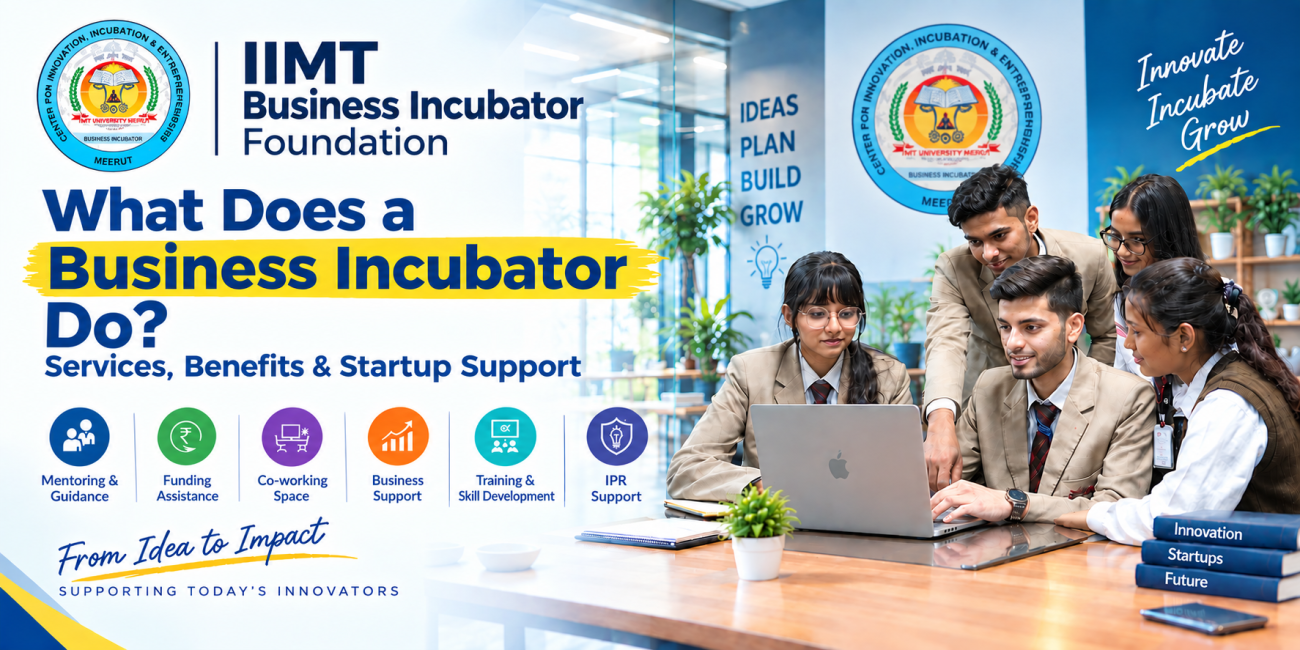
Building a product in isolation is difficult. One of the primary benefits of working with the IIMT Business Incubator Foundation is the opportunity to access specialized business support services. Instead of hiring expensive consultants, student founders can leverage internal expertise to guide their technical and business decisions.
1. Technical Infrastructure
Use campus computer labs, 3D printing facilities, or IoT labs to build your prototype. This drastically lowers the initial “burn rate” of your startup.
2. Expert Mentorship
Access a network of experienced mentors who can help you identify which features are essential and which are distractions. Explore the IIMT BIF mentors and seek guidance relevant to your product and market.
3. Networking & Collaborations
University incubators often have collaborations with industry leaders, providing you with early access to APIs, software credits, or specialized hardware. Learn about IIMT BIF collaborations.
4. Legal and IP Support
Protecting your innovation is vital. Incubation support may include guidance on patenting and company registration, helping founders understand how to safeguard intellectual property from the start.
By utilizing these services, founders can focus their limited time on product-market fit rather than administrative hurdles. This structured environment is designed to help turn academic projects into scalable commercial entities. You can also review the incubator’s business support services.
Step-by-Step Framework to Build Your Minimum Viable Product (MVP)
Step 1: Define the Problem and Your Audience
Start by identifying the exact pain point you are solving. Who is the user? Is it a fellow student, a local vendor in Meerut, or a global enterprise? Use the incubator’s network to conduct surveys and interviews.
Step 2: Identify the Core Value Proposition
What is the one thing your product must do to be successful? If you are building a delivery app, the core value is “getting an item from A to B,” not loyalty points or a dark-mode interface.
Step 3: Select the Right Tech Stack
Avoid over-engineering. In 2026, no-code and low-code platforms can be effective for initial MVPs. Seek advice from the incubator’s technical team to choose tools that are scalable yet cost-effective.
Step 4: Build the “Minimum” Version
Develop a prototype that demonstrates the core functionality. It should be functional enough to provide value but simple enough to be built in a matter of weeks, not months.
Step 5: Launch and Test
Release the product to a small group. University campuses provide an excellent beta-testing ground. Gather data on how users interact with the product and which features they ignore.
Step 6: Measure and Iterate
Analyze the feedback. If the data shows users are struggling with a specific part of the product, pivot or refine. This cycle is the heart of startup growth.
Throughout this process, understanding how to join a business incubator can give you a head start, as you will be surrounded by other founders going through the same journey, providing peer-to-peer learning opportunities.
Common Mistakes Student Founders Should Avoid
While the incubator provides a supportive environment, many founders still fall into common traps. One major error is “Scope Creep”—the tendency to keep adding features before the core product is even tested. This leads to delayed launches and wasted resources.
Another mistake is ignoring the competition; even a unique idea likely competes for a user’s time or money in some way. Research existing alternatives and identify what makes your solution meaningfully different.
Furthermore, many students wait too long to talk to users. They fear someone will “steal the idea” or that the product is not “ready yet.” In the world of startups, speed and feedback are more valuable than secrecy. Use appropriate confidentiality agreements and legal guidance where needed, but do not let fear stop you from validating your MVP with real-world users early on.
Frequently Asked Questions
What is the difference between a prototype and an MVP?
A prototype is often used to test technical feasibility or design—how an idea looks or works—while an MVP is a functional version used to test business viability: will people use or buy it? An MVP is intended to be released to users, whereas a prototype is often used internally.
How much funding do I need for an MVP?
In a university incubator like IIMT BIF, the cost can be low depending on the product and resources available. By using existing labs and student talent, some software MVPs may be developed with very limited spending. Hardware MVPs may require components, which could potentially be supported through seed grants or innovation competitions. Actual costs and funding availability depend on the project and eligibility.
Can I build an MVP without being a coder?
Yes. Many student founders use no-code tools to build functional apps and websites. Alternatively, you can find technical co-founders or collaborators within the university’s engineering departments. An incubator may help facilitate these team-building connections.
When should I stop iterating on my MVP and move to a full product?
You should consider transitioning when you have evidence of product-market fit. This may be indicated by consistent user growth, strong retention, repeat usage, or willingness to pay. At this stage, you can evaluate larger funding requirements and plan how to scale the product and its infrastructure.
Conclusion
Building a Minimum Viable Product (MVP) is a critical step in a student founder’s journey. It transforms a theoretical concept into a tangible asset that can be tested, refined, and funded. By following a structured framework—focusing on core utility, leveraging university incubator resources, and embracing a culture of feedback—you can make more informed decisions and improve your chances of success in the startup landscape.
The IIMT Business Incubator Foundation (IIMT BIF) aims to provide infrastructure, mentorship, and business support to help founders navigate this path. Don’t wait for the “perfect” version; start building today, learn from your users, and iterate your way towards a sustainable business.
Ready to Turn Your Idea into Reality?
We invite you to apply for incubation at IIMT BIF using the incubation application form or explore our full range of entrepreneurial services.
www.iimtciie.com