
Converting Your Final Year Project into a Startup: A Practical Guide for Indian Students
Every year, millions of Indian engineering, management, and science students complete their final year projects, only for the majority of these reports to gather dust in university libraries. However, in the evolving economic landscape of 2026, these academic requirements are increasingly becoming the foundation for innovative new businesses. This guide explores the systematic path of Converting Your Final Year Project into a Startup, helping you bridge the gap between academic theory and commercial reality.
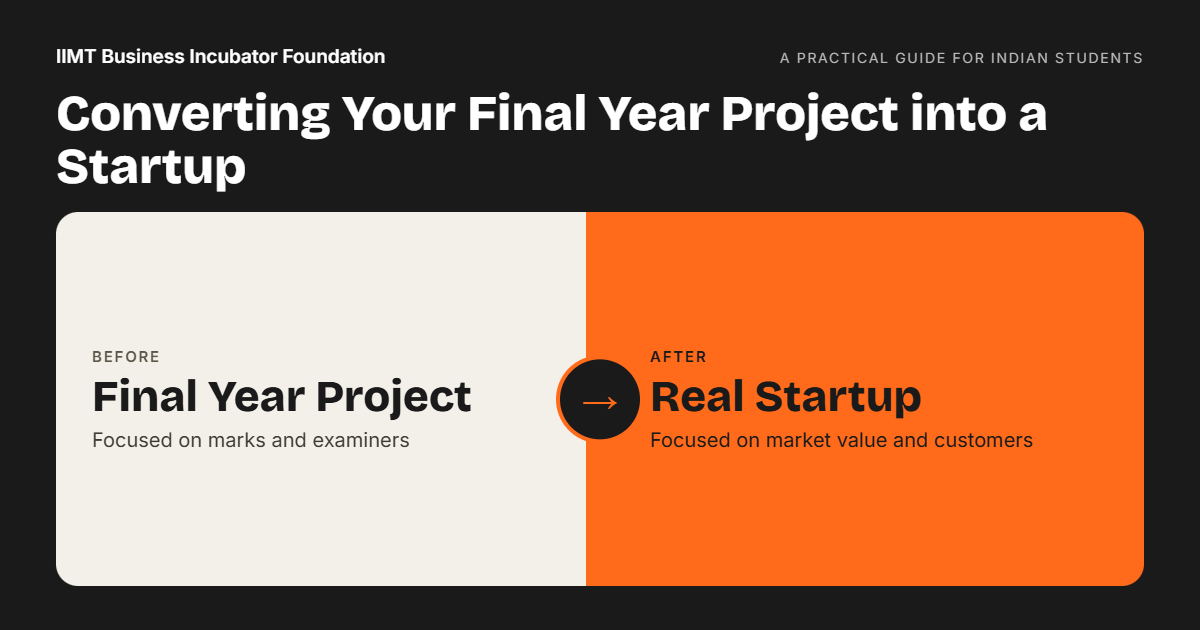
The journey from a classroom assignment to a registered company requires a shift in mindset—from focusing on “marks” to focusing on “market value.” By following a structured approach involving validation, intellectual property protection, and incubation support from organizations like IIMT Business Incubator Foundation (IIMT BIF), you can transform your technical prototype into a scalable enterprise that solves real-world problems.
Quick Verdict
Yes, your final year project can become a startup if it solves a significant pain point for a specific customer base. Success requires moving beyond technical feasibility to focus on market validation, team building, and professional incubation support.
Quick Overview
Problem Validation
Verify market demand
Customer Survey Insights
MVP Development
Build a functional version
Minimum Viable Product
Legal & IP
Protect the innovation
Company Registration / Patent
Incubation
Scale and network
Seed Funding Readiness
Why Your Final Year Project is the Perfect Startup Launchpad
Final year projects offer a unique advantage because they provide a dedicated timeframe for research and development. Unlike traditional startup founders who must juggle work and product building, students have access to university labs, faculty expertise, and a peer group of potential co-founders. In the context of university incubators and student entrepreneurship, these projects serve as low-risk experiments where the “cost of failure” is relatively low.
In 2026, the Indian government through initiatives like Startup India has further simplified the process for students to claim “Startup” status. This means your academic prototype could be eligible for grants and tax benefits even before you graduate. The key is to ensure that your startup ideas for college students are grounded in feasibility and scalability.
From Technical Prototype to Marketable Product
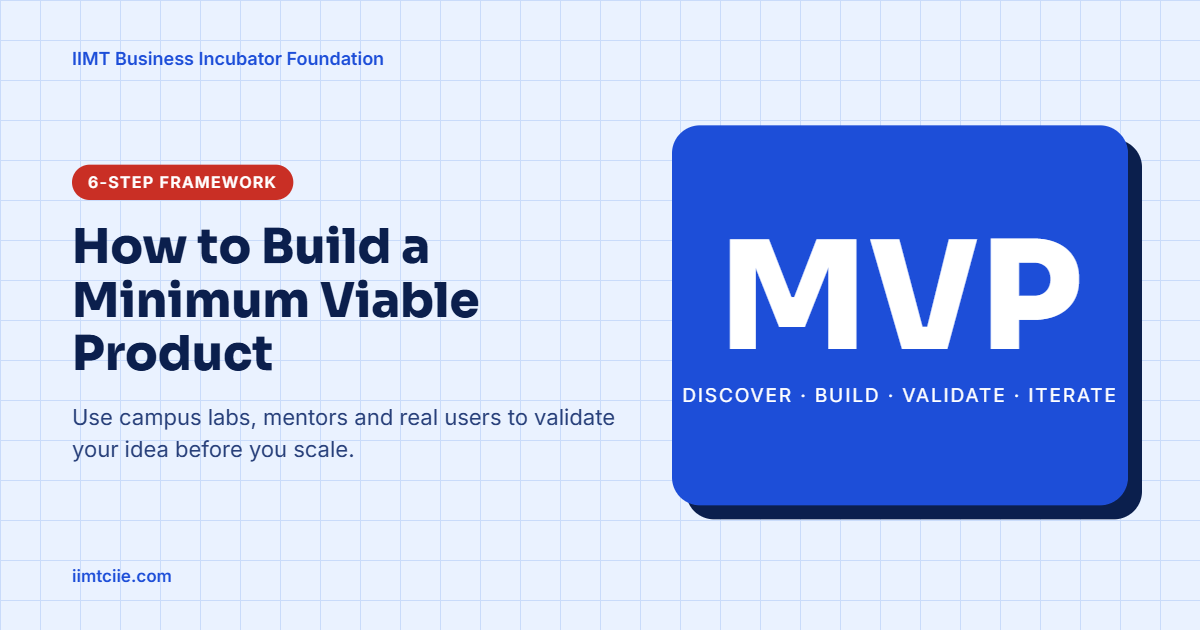
A project is often designed to showcase your technical skills to an examiner. A startup, however, is designed to provide value to a customer. To transition, you must strip away unnecessary academic features and focus on the “core” functionality that people are willing to pay for. This is often referred to as the Minimum Viable Product (MVP).
Navigating the Legalities of Converting Your Final Year Project into a Startup
One of the most common hurdles for students is understanding ownership. Since the project was developed within a college ecosystem, does the university own it? Most modern Indian universities and the National Innovation and Startup Policy (NISP) allow students to retain ownership of their innovations, but it is vital to check your specific institution’s policy early on.
Once ownership is clear, the next step is how to register a startup in India. You should decide between a Private Limited Company, a Limited Liability Partnership (LLP), or a One Person Company (OPC). For most tech startups seeking venture capital in the future, a Private Limited Company is the standard choice. Ensure you also explore Intellectual Property (IP) filing if your project involves a unique invention or software algorithm.
Building the Right Founding Team
Most final year projects are done in groups of 3 or 4. However, your project partners may not all want to be entrepreneurs. Some might prefer stable corporate jobs. It is essential to have honest conversations about commitment. To succeed, you must learn how to build a strong startup team where every member brings a specific skill—such as technical development, marketing, or operations.
The Role of IIMT BIF in Your Entrepreneurial Journey
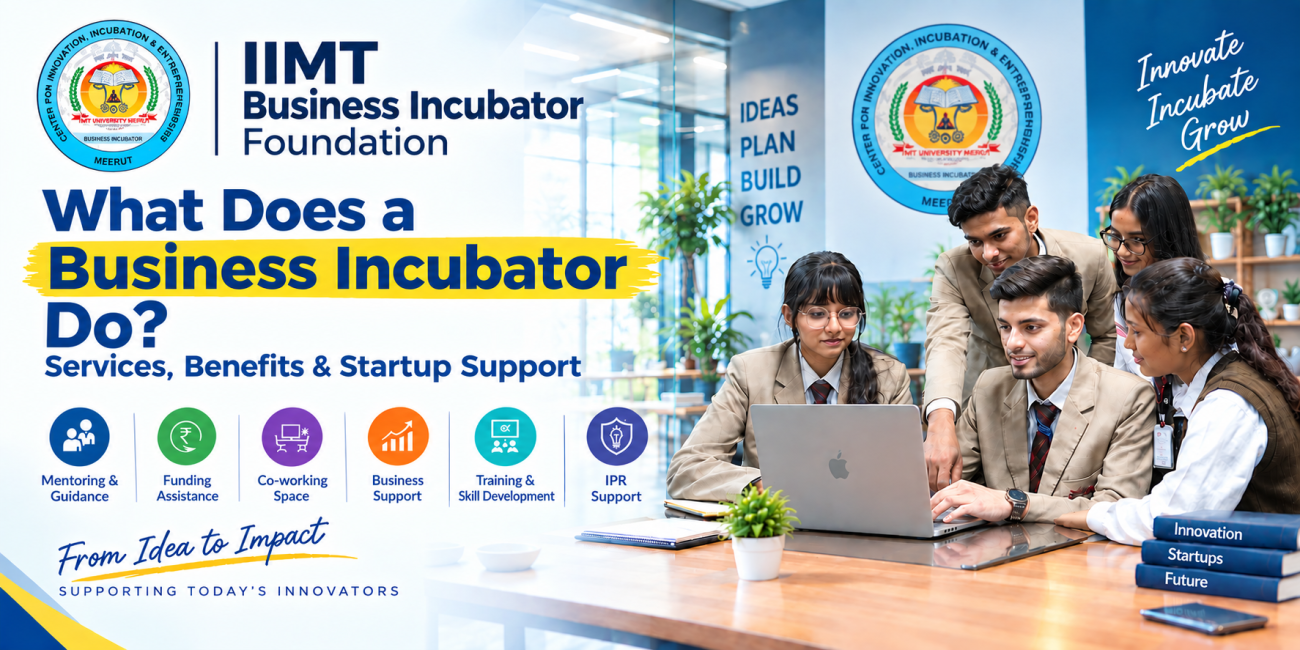
For students in the Meerut and NCR region, IIMT Business Incubator Foundation (IIMT BIF) acts as a critical bridge. Converting your final year project into a startup is significantly easier when you have access to professional mentorship. IIMT BIF provides the infrastructure, such as co-working spaces and high-speed internet, which reduces the initial overhead costs for student founders.
Mentorship Matters
Beyond physical space, IIMT BIF connects students with industry experts who can help refine business models. In 2026, the competition for consumer attention is fierce, and having a mentor who has “been there and done that” can prevent common mistakes. Furthermore, being part of an incubator helps you access government schemes like the UP Startup Policy and Startup India Seed Fund Scheme.
Step-by-Step Guide to the Transition
Step 1: Identify the Problem
Does your project solve a real pain point? Talk to at least 50 potential users outside your college to validate the need.
Step 2: Refine the MVP
Remove “academic fluff.” Focus on the one feature that solves the user’s primary problem.
Step 3: Select Your Co-founders
Finalize who is staying for the long term. Draft a basic founders’ agreement to avoid future disputes.
Step 4: Register Your Startup
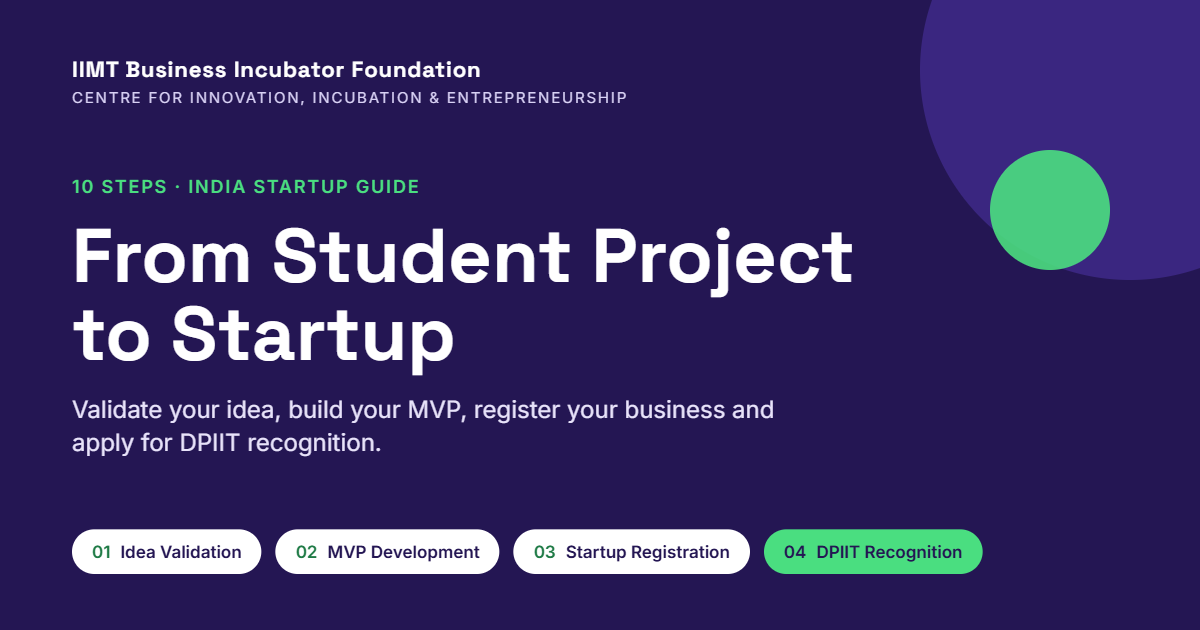
Use the Startup India portal to get your DPIIT recognition, which opens doors to various schemes.
Step 5: Apply for Incubation
Join an incubator like IIMT BIF to get the mentorship and networking opportunities needed to find your first paying customers.
Step 6: Seek Seed Funding
Look for government grants or angel investors who specifically focus on early-stage student-led innovations.
Frequently Asked Questions
Does my college own my final year project?
In most cases, students own the IP, especially if it was developed using standard college facilities. However, if you used specific high-value university patents or research grants, the college might have a claim. Always check your university’s IPR policy.
When is the best time to start the transition?
The best time is during your seventh or eighth semester. Use your final semester to conduct market research and build the MVP while you still have the safety net of being a student.
Can I get funding for a project that isn’t fully built yet?
Yes, many government grants in 2026 are specifically designed for “proof of concept” (PoC) stages. However, private investors usually prefer seeing a functional prototype or some initial user traction.
What if my project partners want to take a job instead?
This is common. You can continue the startup alone or find new co-founders. If your former partners contributed to the original IP, you might need a “No Objection Certificate” (NOC) or an agreement to buy out their share of the intellectual property.
Conclusion
The process of Converting Your Final Year Project into a Startup is a challenging but rewarding path that transforms you from a job seeker into a job creator. As we look toward 2026, the resources available to Indian students—from government grants to university-led incubators—have never been more accessible. Success lies in your ability to look beyond the technical code or mechanical design and see the human problem your project solves.
Don’t let your hard work end at the examination hall. Take the leap, validate your idea, and leverage the support systems available to you. Organizations like IIMT BIF are here to ensure that your innovation finds its way from the classroom to the marketplace.
Ready to Turn Your Project into a Startup?
Take your project to the next level by applying for professional mentorship and support at IIMT BIF using our incubation application form or learn more about our services.
www.iimtciie.com