
Intellectual Property Rights Strategy for Indian Startups: Protecting Innovation during the Incubation Phase
In the rapidly evolving Indian entrepreneurial ecosystem of 2026, a startup’s most valuable asset is often its intangible property. Developing a comprehensive Intellectual Property Rights Strategy for Indian Startups is no longer a luxury reserved for tech giants; it is a foundational necessity for any early-stage venture entering an incubator. Without proper protection, your innovative business model, unique software code, or industrial design can be replicated by competitors before you even reach the market-entry stage.
This article explores how aspiring entrepreneurs can safeguard their intellectual capital during the critical incubation phase. We will delve into the types of IP relevant to the Indian context, government incentives for startups, and how organizations like the IIMT Business Incubator Foundation (IIMT BIF) help founders navigate the legal complexities of patenting and trademarking their ideas.
QUICK VERDICT
An effective Intellectual Property Rights Strategy for Indian Startups involves early identification of IP assets, leveraging the SIPP scheme for 80% fee rebates, and ensuring all co-founder and employee agreements include clear IP assignment clauses during the incubation period.
Quick Overview
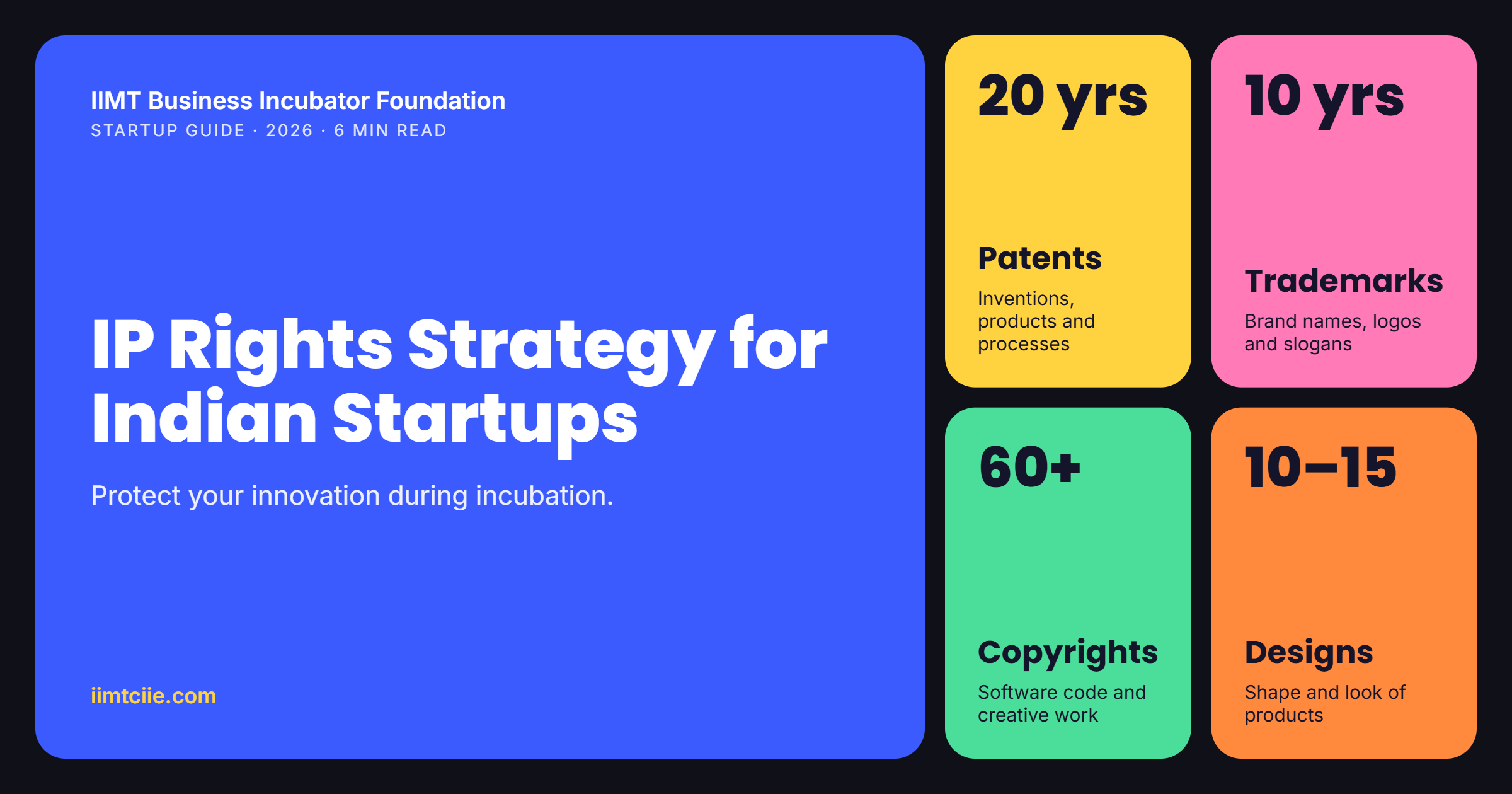
Protects: Inventions (Products/Processes)
Duration (India): 20 Years
Key Benefit: Provides a 20-year market monopoly.
Protects: Brand Name, Logos, Slogans
Duration (India): 10 Years (Renewable)
Key Benefit: Builds brand identity and prevents imitation.
Protects: Software Code, Literary Works
Duration (India): Lifetime + 60 Years
Key Benefit: Protects original creative expressions.
Protects: Aesthetic Shape/Configuration
Duration (India): 10-15 Years
Key Benefit: Prevents visual copying of products.
Why IP Strategy is Critical During Incubation
The incubation phase is where an idea transforms into a prototype. This is also the period where startups are most vulnerable. Sharing your concept with mentors, potential partners, and early-stage investors is necessary for growth, but it carries the risk of intellectual theft if an Intellectual Property Rights Strategy for Indian Startups is not in place. A well-defined strategy ensures that you own the rights to your innovation from day one.
Furthermore, intellectual property significantly impacts startup valuation. In 2026, investors are increasingly looking for “defensible moats.” A startup with a pending patent or a registered trademark is seen as a more secure investment. It proves that the founders have done their due diligence and are serious about dominating their niche. For student entrepreneurs, understanding university incubators and student entrepreneurship dynamics is key to knowing who owns the IP developed on campus.
IIMT BIF emphasizes IP awareness because it protects the hard work of student innovators. By securing IP early, startups can prevent larger corporations from “bullying” them out of the market or engaging in costly legal battles later in the business lifecycle. Most importantly, it allows the startup to license its technology, creating an additional revenue stream even before the product hits the shelves.
Why It Matters
A startup with a pending patent or a registered trademark is seen as a more secure investment, because it proves the founders are serious about defending their niche.
Key Components of a Robust IP Strategy
Building an Intellectual Property Rights Strategy for Indian Startups requires a multi-layered approach. It is not just about filing a single patent; it is about creating a “protective shield” around every aspect of your business. Here are the core pillars to focus on:
1. IP Audit and Identification
Startups often fail to realize they have multiple types of IP. A fintech startup might have a patentable algorithm, a copyrighted user interface, and a trademarked brand name. Conducting an internal IP audit helps you list every asset that needs protection. This is often the first step when you join a business incubator like IIMT BIF, where mentors help you categorize your innovations.
2. Confidentiality and NDAs
Before any formal filing, confidentiality is your best friend. Non-Disclosure Agreements (NDAs) should be standard practice when dealing with third-party vendors, manufacturers, or even potential co-founders. Ensure that all employees sign “Invention Assignment Agreements,” which state that any work they produce while employed belongs to the company, not the individual.
3. Freedom to Operate (FTO) Search
An Intellectual Property Rights Strategy for Indian Startups must include a “Freedom to Operate” analysis. There is no point in building a product if it unknowingly infringes on someone else’s existing patent. An FTO search ensures your path is clear, saving you from future litigation and the need to pivot after significant investment has been made.
Government Support and Schemes for 2026
The Government of India has introduced several measures to make IP protection affordable for small businesses. Under the “Startup India” initiative, the Scheme for Startups Intellectual Property Protection (SIPP) has been a game-changer. This scheme facilitates startups in filing patents, trademarks, and designs through empaneled facilitators.
✓ Fee Rebates
Startups are eligible for an 80% rebate on patent filing fees and a 50% rebate on trademark filing fees compared to large companies.
✓ Fast-Track Disposal
Patent applications for startups are fast-tracked, significantly reducing the time from application to grant.
✓ Free Legal Facilitation
The government bears the cost of the facilitator’s fees, meaning the startup only pays the statutory filing fees.
To avail of these benefits, founders should first understand how to register a startup in India through the DPIIT (Department for Promotion of Industry and Internal Trade). Once recognized as a startup, these IP benefits become readily accessible, making the cost of protection manageable for even the most cash-strapped student founders.
How IIMT BIF Facilitates IP Protection
At IIMT Business Incubator Foundation, we recognize that the legal jargon of IPR can be overwhelming for young innovators. Our incubation program integrates IP support into the core services provided to startups. We connect founders with legal experts and IP attorneys who specialize in the Indian legal landscape.
Through our regular workshops, we educate students on how to document their “Lab Notebooks” to prove the date of invention—a critical piece of evidence in patent disputes. We also provide infrastructure and networking opportunities that allow startups to collaborate with researchers without fearing the loss of their proprietary technology. Our goal is to ensure that every startup graduating from IIMT BIF has a portfolio of protected assets that increases their market readiness.
Step-by-Step Guide to Securing Your IP
1Document the Idea
Maintain a detailed record of the invention process, including dates, sketches, and experimental results.
2Check for Uniqueness
Use the Indian Patent Office (Ipindia.gov.in) and international databases (WIPO) to search for prior art or existing trademarks.
3File a Provisional Patent
If the invention is not yet fully refined, file a provisional patent to secure a “Priority Date.” You then have 12 months to file the complete specification.
4Register Your Trademark
Secure your brand name and logo as soon as you begin your incubation journey to build brand equity.
5Formalize Agreements
Ensure all IP assignment clauses are included in founder agreements and employment contracts.
6Monitor the Market
Regularly check for infringements. Having a right is useless unless you are prepared to defend it.
Frequently Asked Questions
Conclusion
A successful Intellectual Property Rights Strategy for Indian Startups is the bridge between a good idea and a sustainable business. By prioritizing IP protection during the incubation phase, founders can secure their innovations, enhance their company’s valuation, and leverage government incentives designed to foster growth. In 2026, the competitive edge belongs to those who not only innovate but also protect.
Don’t let your hard work go unprotected. Start building your IP portfolio today to ensure your startup remains resilient in a crowded market.
Ready to Protect Your Innovation?
Take the first step in securing your innovation by applying for incubation at IIMT BIF using the incubation application form or explore our services to learn how we can help you with IP management.
www.iimtciie.com