
IIMT University Supports Student Entrepreneurs Through Education, Innovation and Business Incubation
A strong startup often begins with a simple idea: a student notices a problem and starts thinking about a better solution. Universities can play an important role in turning that curiosity into practical innovation by providing students with opportunities to learn, experiment, receive mentorship and understand how businesses are developed.
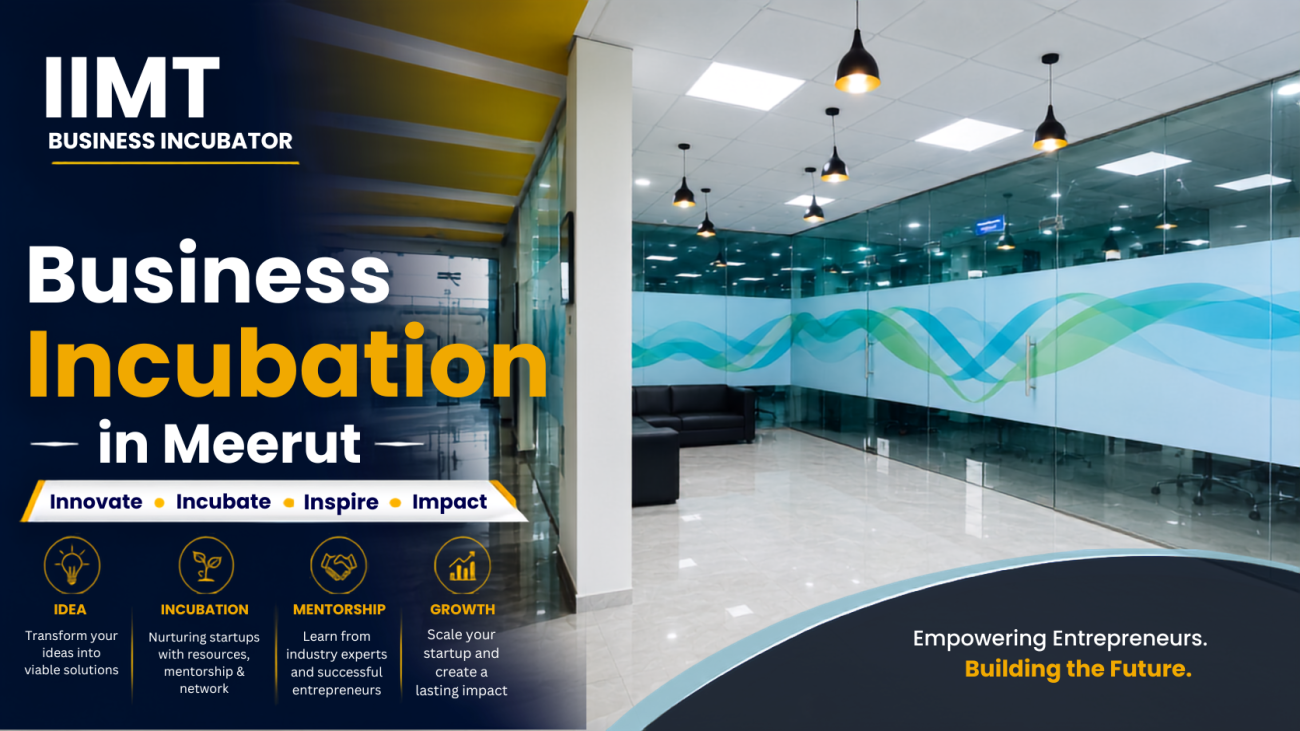
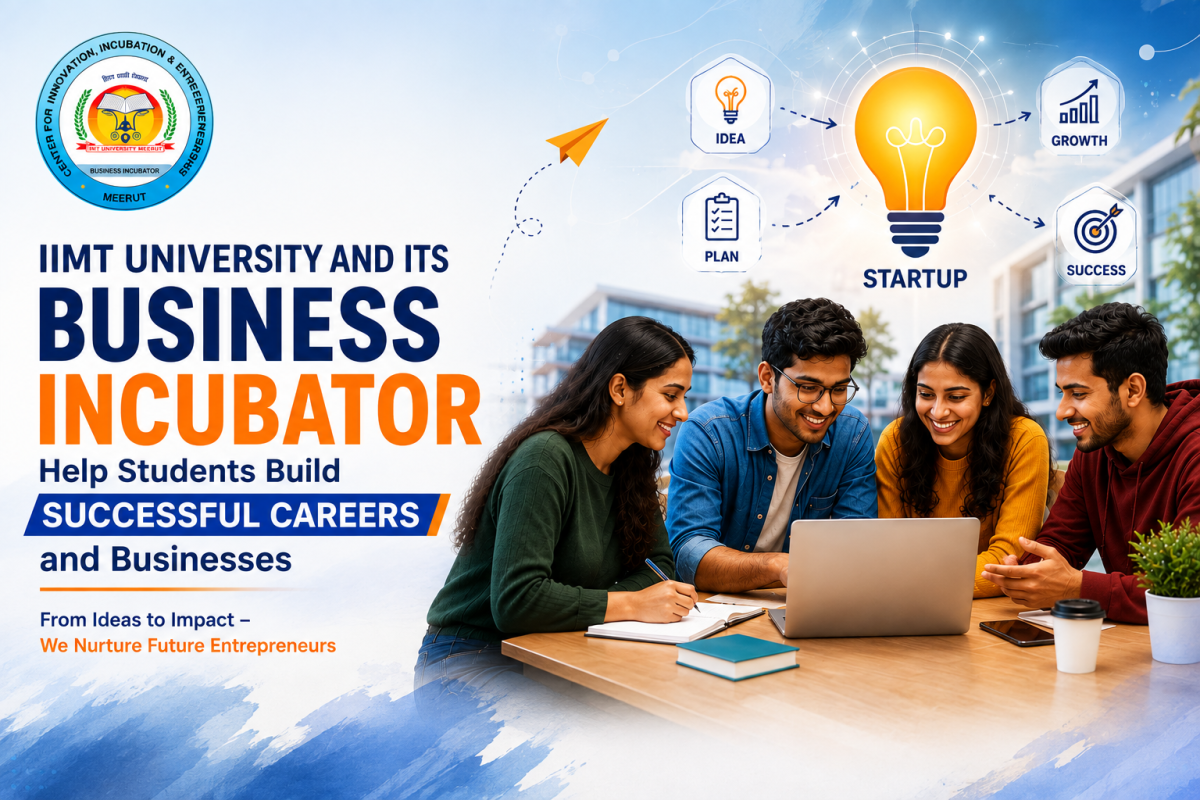
At IIMT University, entrepreneurship is supported through an ecosystem that connects education, innovation and business incubation. The IIMT Business Incubator Foundation (IIMT-BIF) provides pre-incubation and incubation facilities for students, startups and aspiring entrepreneurs, helping them develop ideas and understand the process of building early-stage ventures.
Why Student Entrepreneurship Matters in Higher Education
Student entrepreneurship is about more than starting a company while studying. It helps learners develop skills that can be useful across different careers.
When students work on entrepreneurial ideas, they learn to identify problems, research potential solutions and make practical decisions. They also develop creativity, communication, leadership and problem-solving abilities.
Entrepreneurship can provide students with exposure to:
- Business planning and decision making
- Market research and customer understanding
- Product and service development
- Team building and leadership
- Innovation and problem solving
- Industry interaction
- Self-employment and startup development
This practical approach complements classroom education by allowing students to connect academic knowledge with real-world challenges.
How IIMT University Supports Student Entrepreneurs
IIMT University’s entrepreneurship ecosystem brings together academic learning, innovation and incubation. Its Business Incubator Foundation works with students, startups and aspiring entrepreneurs through pre-incubation and incubation facilities. The foundation states that it supports areas including engineering and technology, biotechnology, pharmaceuticals and information technology.
This environment can help students move beyond simply discussing an idea. With appropriate guidance, they can explore whether an idea addresses a genuine problem, understand its potential market and work toward developing a practical solution.
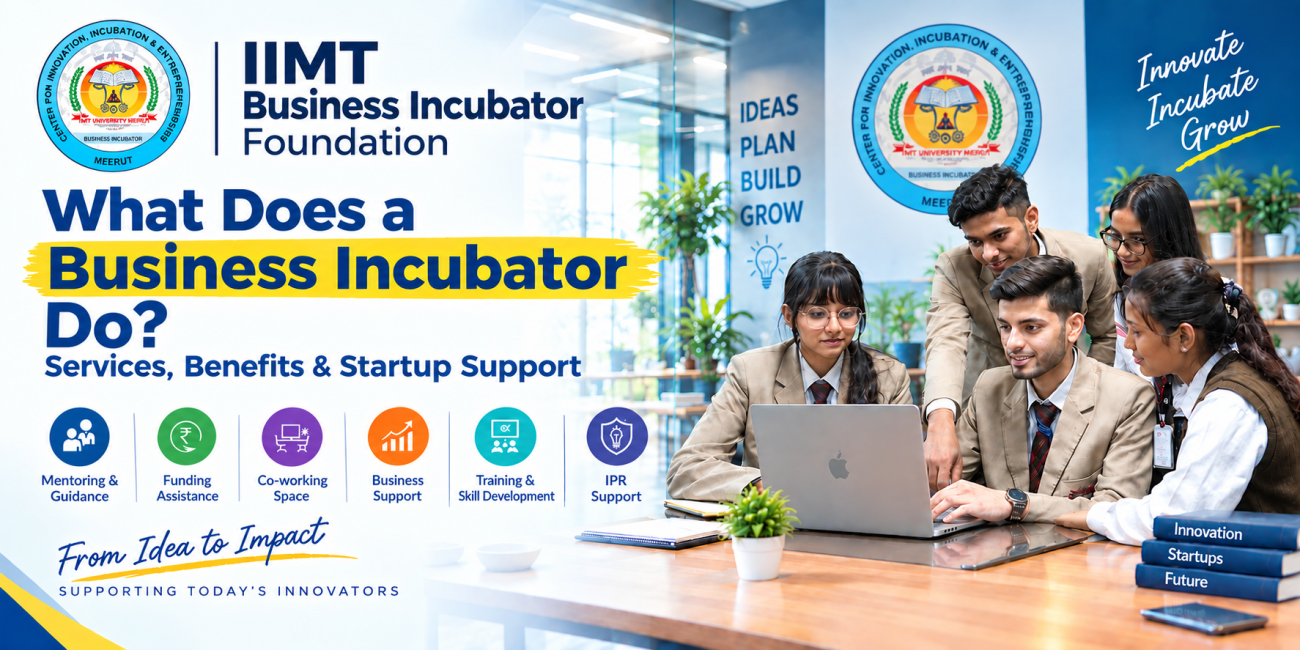
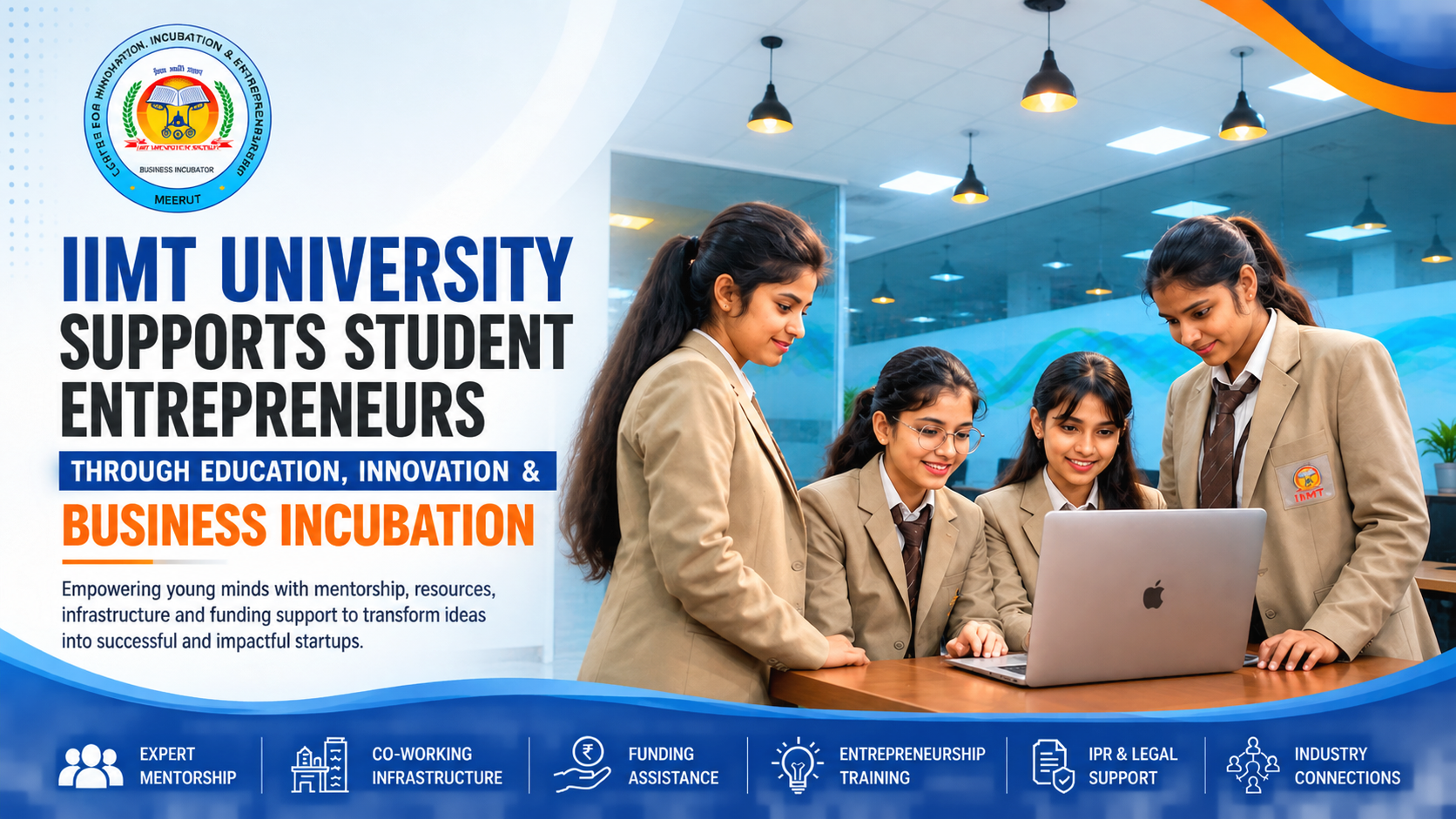
The IIMT-BIF services include business support and consulting, co-working spaces, mentoring, funding assistance, training and IPR support.
Role of the IIMT Business Incubator Foundation
The IIMT Business Incubator Foundation is designed to help aspiring entrepreneurs navigate the early stages of business development.
Its incubation ecosystem provides support such as:
- Pre-incubation and incubation: Helping early ideas and startups progress through structured development.
- Mentoring: Providing guidance related to business strategy, investors, company development and other entrepreneurial decisions.
- Business support: Helping entrepreneurs work through practical business challenges.
- Co-working infrastructure: Providing workspace and associated facilities for startup teams.
- Funding assistance: Supporting startups in exploring appropriate early-stage funding opportunities.
- Training: Connecting learning with real-world entrepreneurial and workforce development.
- IPR support: Providing assistance related to patents, trademarks and copyright protection.
The foundation also operates an incubation program that includes mentorship, workshops, resources, pitch training, investor connections and incubation support. Funding support is described as access to potential opportunities and schemes rather than a guarantee of funding.
From Student Idea to Startup: How Incubation Helps
A student with an innovative idea does not necessarily need to have a complete business plan on day one. Startup development is generally a process of learning, testing and improving.
A practical journey can include:
- Identify a problem – Start with a genuine problem faced by people, businesses or communities.
- Develop the idea – Think about how the proposed solution can address that problem.
- Validate the idea – Research customers, competitors and market requirements.
- Build a prototype or MVP – Create an initial version of the product or service.
- Seek mentorship – Discuss the idea with experienced mentors and industry professionals.
- Develop the business model – Understand customers, costs, revenue and operations.
- Consider intellectual property – Identify whether patents, trademarks or copyrights may be relevant.
- Prepare for funding – Understand available funding routes and investor expectations.
- Build industry connections – Explore networking, collaboration and market opportunities.
- Launch and improve – Test the product, learn from feedback and work toward sustainable growth.
An incubator can provide guidance and resources at several stages of this journey.
Key Benefits of Business Incubation for Students
Business incubation can reduce some of the difficulties faced by first-time entrepreneurs by giving them access to support and resources.
Expert Mentorship
Experienced mentors can help founders think through business strategy, product development, market opportunities and important decisions. IIMT-BIF specifically provides mentoring support for startups and entrepreneurs.
Business Planning
A promising idea needs a practical plan. Business support can help students understand their target market, operations, financial requirements and growth objectives.
Funding Guidance
Funding can be an important consideration for early-stage startups. IIMT-BIF provides funding assistance intended to help startups explore early-stage financial support. This should be understood as assistance and guidance, not an automatic funding commitment.
Infrastructure and Workspace
Access to co-working facilities and startup infrastructure can give early-stage founders a more suitable environment for developing their ventures.
IPR Guidance
Protecting intellectual property can become important when students develop original technologies, products, brands or creative solutions. IIMT-BIF provides support related to patents, trademarks and copyright protection.
Entrepreneurship Education and Innovation at IIMT University
Entrepreneurship education becomes more valuable when students can apply what they learn.
Academic knowledge in technology, engineering, pharmacy, biotechnology, management or information technology can provide a foundation for identifying real-world problems. Incubation can then help students explore how that knowledge could be converted into products, services or business solutions.
This combination of education, research, innovation and entrepreneurship encourages students to think about how their skills can create practical value.
Mentorship, Funding and Industry Connections
Three areas are particularly important for early-stage founders: mentorship, funding and industry connections.
Mentorship can help students understand business strategy, market requirements, product development and decision-making.
Funding support can help founders learn about available government schemes, grants, investors and other potential funding routes. IIMT-BIF’s published incubation information includes access to potential funding opportunities and investor connections.
Industry connections can provide opportunities for networking, collaboration and exposure to real business requirements. IIMT-BIF also lists collaborations with ecosystem organizations and technology providers as part of its wider startup network.
Business Incubation in Meerut and Uttar Pradesh
A university-based business incubator can contribute to the local startup ecosystem by giving students and aspiring founders access to entrepreneurial resources closer to their educational environment.
For students searching for a business incubator in Meerut, an incubation centre can provide a bridge between academic learning and startup development. It can help young innovators understand how ideas are tested, developed and prepared for the market.
The broader goal is to encourage innovation and entrepreneurship in Uttar Pradesh by helping early-stage founders develop practical solutions and businesses.
How Students Can Start Their Entrepreneurial Journey
Students interested in entrepreneurship do not have to wait until graduation to begin exploring an idea.
A useful starting point is to:
- Identify a real problem.
- Research the market and potential customers.
- Develop a clear solution.
- Discuss the concept with mentors.
- Build and test a prototype.
- Collect feedback.
- Create a basic business model.
- Explore intellectual-property requirements.
- Research suitable funding opportunities.
- Consider pre-incubation or incubation support.
Students interested in developing their ideas can explore the incubation ecosystem provided by IIMT-BIF and determine which available services or programs are appropriate for their stage of development.
Frequently
What is student entrepreneurship?
Student entrepreneurship involves students developing business ideas, innovative solutions or startups while pursuing their education.
How does IIMT University support student entrepreneurs?
IIMT University supports entrepreneurship through an ecosystem involving innovation, academic learning and the IIMT Business Incubator Foundation, which provides pre-incubation and incubation facilities.
What is the IIMT Business Incubator Foundation?
IIMT-BIF is a non-profit entity focused on research, innovation, incubation and startups, with facilities for students, startups and aspiring entrepreneurs.
What is business incubation?
Business incubation is a structured support process that helps early-stage startups develop through mentoring, resources, training, infrastructure and business guidance.
Does IIMT-BIF provide startup mentorship?
Yes. Mentoring support is one of the services listed by IIMT-BIF for startups and entrepreneurs.
Does IIMT-BIF provide funding assistance?
Yes. IIMT-BIF lists funding assistance as a service. However, funding assistance should not be interpreted as guaranteed funding for every startup.
What support is available for student startups?
Depending on the program and startup stage, support can include mentoring, workspace, training, business assistance, funding guidance and IPR support.
How can students develop their business ideas?
Students can begin by identifying a real problem, researching the market, creating a prototype, testing the idea and seeking feedback from mentors and potential users.
Why is entrepreneurship education important?
It develops practical skills such as problem-solving, creativity, leadership, decision-making and business thinking while connecting academic learning with real-world challenges.
Conclusion
Student entrepreneurship can turn classroom learning into practical innovation. When students receive the right guidance, resources and opportunities, an early idea can develop into a product, service or startup.
IIMT University’s entrepreneurship ecosystem, supported by the IIMT Business Incubator Foundation, provides a platform where students and aspiring entrepreneurs can explore innovation, receive mentorship, access incubation resources and learn about the practical aspects of startup development.
For aspiring IIMT University student entrepreneurs, the first step does not have to be a fully developed company. It can simply be a problem worth solving, followed by research, experimentation, mentorship and continuous improvement. Exploring business incubation can help students take that first idea toward a more structured entrepreneurial journey.