
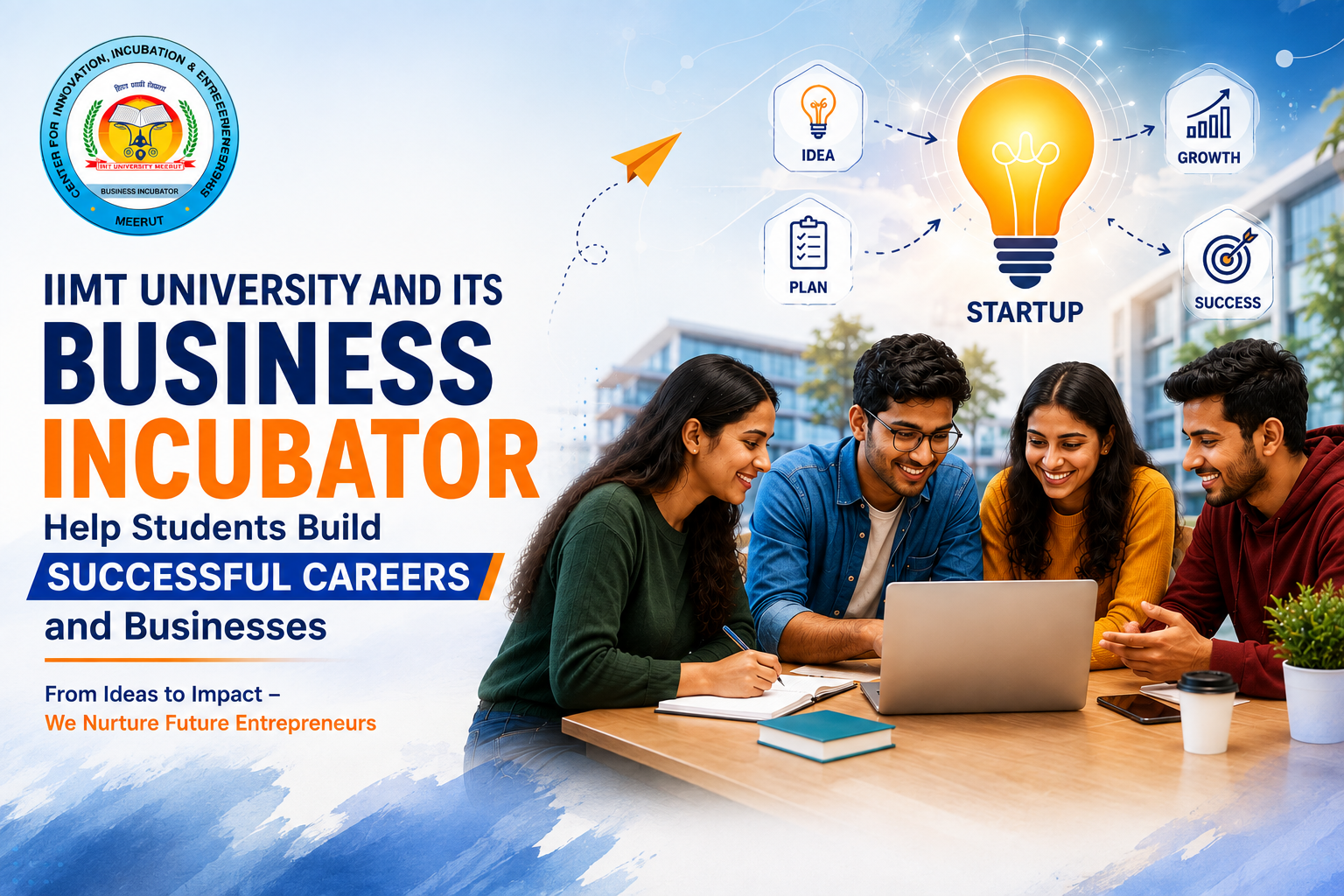
How IIMT University and Its Business Incubator Help Students Build Successful Careers and Businesses
Introduction
Higher education is no longer limited to preparing students for conventional employment. Students today can explore careers in entrepreneurship, startups, innovation, freelancing, business development, and emerging industries. Along with academic knowledge, they need practical skills, industry exposure, problem solving abilities, and opportunities to apply what they learn.
This is where a university entrepreneurship ecosystem and a business incubator for students can make a meaningful difference. The IIMT University Business Incubator connects academic learning with entrepreneurship by providing an environment where students and aspiring founders can develop ideas, learn from mentors, explore business opportunities, and understand the process of building a venture.
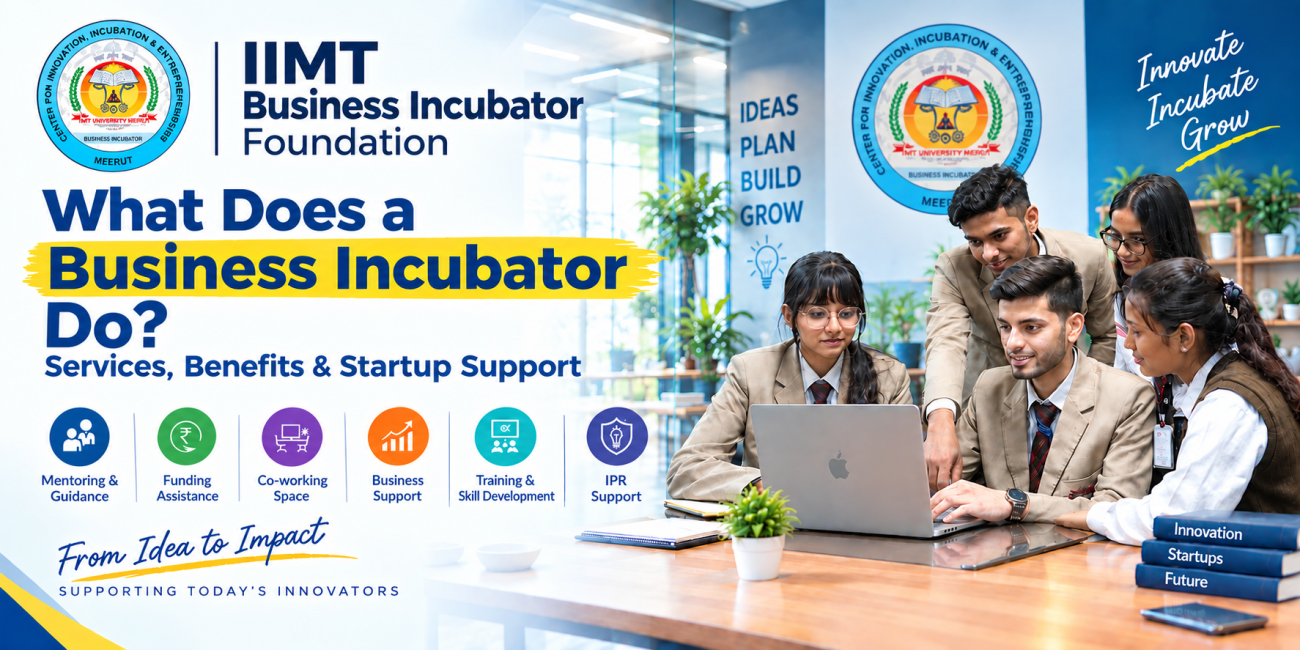
The IIMT Business Incubator Foundation focuses on areas such as incubation, mentoring, training, infrastructure, funding assistance, and intellectual property support, helping students understand entrepreneurship beyond the classroom.
Why Entrepreneurship Matters for University Students
Entrepreneurship gives students an opportunity to turn problems into potential solutions. Even students who do not eventually become founders can benefit from entrepreneurial experience.
Developing a startup idea can help students strengthen:
- Problem solving and innovation
- Communication and presentation
- Leadership and teamwork
- Business and financial understanding
- Digital marketing and sales
- Project management
- Networking and decision-making
India’s growing startup environment also creates opportunities for students to explore new business models and technology-driven solutions. University entrepreneurship can therefore become an important part of career development through entrepreneurship.
What Is a Business Incubator?
A business incubator is an organized support environment that helps early-stage entrepreneurs develop and test their ideas. Instead of simply having an idea, a student can use incubation support to understand whether the idea solves a genuine problem and whether there is a potential market for it.
A typical incubation journey may include:
Idea → Validation → Mentorship → Business Model → Prototype → Funding → Launch → Growth
Depending on the program and the startup’s requirements, support may include mentoring, business planning, market research, networking, infrastructure, training, funding guidance, and intellectual property assistance.
For students, this provides a structured way to move from classroom concepts toward practical entrepreneurship.
How the IIMT University Business Incubator Supports Students
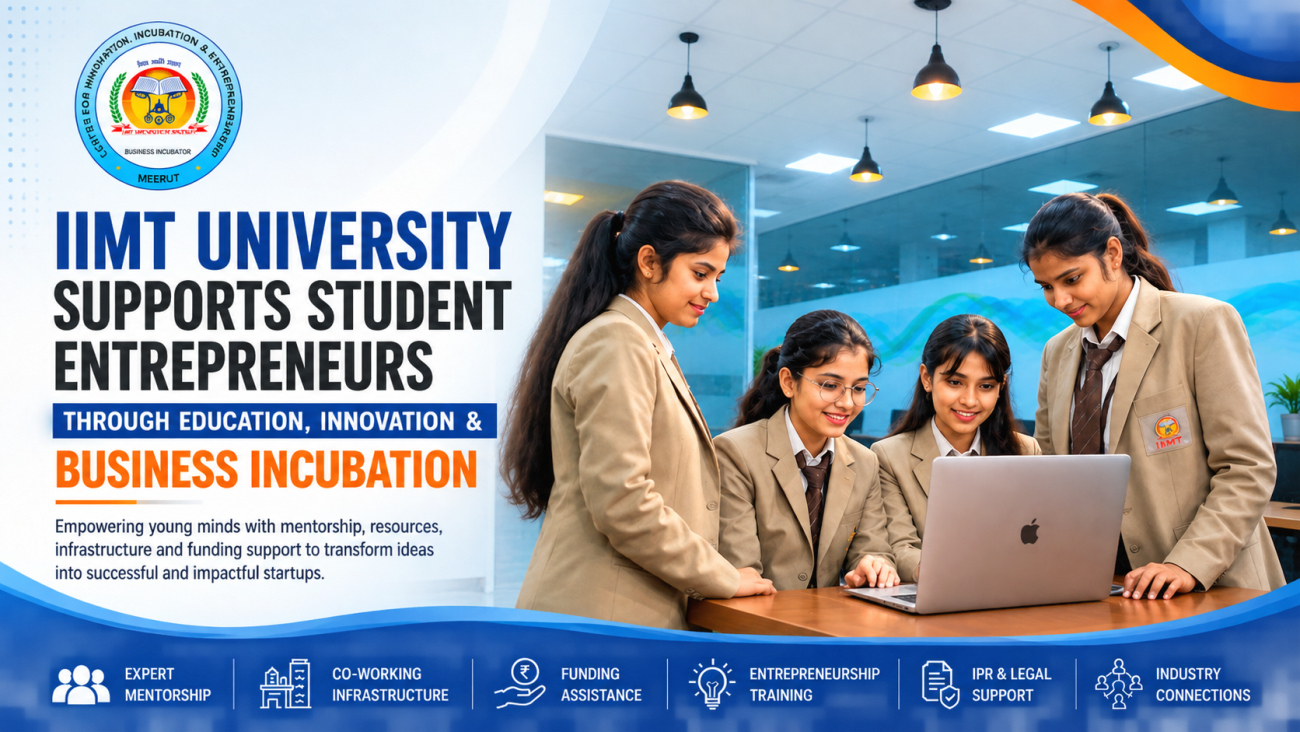
The IIMT Business Incubator Foundation provides an entrepreneurship-oriented environment for students and aspiring entrepreneurs. Its support areas include business consulting, co-working facilities, mentoring, funding assistance, workforce development, and IPR support.
The foundation also describes pre-incubation and incubation facilities, training, mentorship, infrastructure, and funding support. These services can help aspiring founders understand different stages of startup development and make more informed business decisions.
For a student, the value of such an ecosystem is not only the physical infrastructure. Access to guidance, business knowledge, networks, and practical exposure can help transform an initial concept into a more structured business proposition.
From Student Idea to Startup
A student interested in entrepreneurship can begin with a simple problem rather than immediately trying to create a company.
1. Identify a Problem
Look for a genuine problem faced by students, consumers, businesses, or communities.
2. Research the Market
Understand existing solutions, competitors, customer requirements, and market gaps.
3. Validate the Idea
Talk to potential users and collect feedback before investing significant time or money.
4. Develop a Business Model
Determine who the customer is, what value the product provides, how it will reach users, and how the business could generate revenue.
5. Build a Prototype
A prototype or minimum viable product can help test the concept with real users.
6. Seek Mentorship
Experienced guidance can help students evaluate their strategy, pricing, marketing, team structure, and financial planning.
7. Explore Incubation and Funding
Students can explore suitable incubation programs and investigate grants, government schemes, investors, seed opportunities, or other funding options. Funding assistance should not be understood as a guarantee of receiving investment.
8. Launch and Improve
Once the product or service is ready, entrepreneurs can launch, measure customer response, identify weaknesses, and continuously improve.
Mentorship and Business Guidance
One of the biggest challenges for student entrepreneurs is limited business experience. A student may have a strong technical idea but still need help with customer research, pricing, marketing, finance, or scaling.
Mentorship can provide a practical perspective on:
- Business strategy
- Customer validation
- Market research
- Business models
- Marketing and sales
- Team building
- Financial planning
- Product development
- Scaling
This makes startup mentorship for students an important part of an entrepreneurship ecosystem.
How Incubation Can Improve Career Readiness
Entrepreneurship experience can be valuable even when a student eventually chooses employment instead of starting a company.
Working on a startup idea can expose students to real-world responsibilities such as managing projects, presenting ideas, communicating with customers, planning budgets, and working within teams.
These experiences can strengthen skills relevant to careers such as:
- Entrepreneur or startup founder
- Business development professional
- Product manager
- Marketing professional
- Business analyst
- Project manager
- Startup operations professional
- Innovation professional
Incubation does not guarantee employment, business success, or funding. Instead, it provides opportunities for students to develop practical capabilities that can support different career directions.
Why Meerut Students Can Benefit From Local Business Incubation
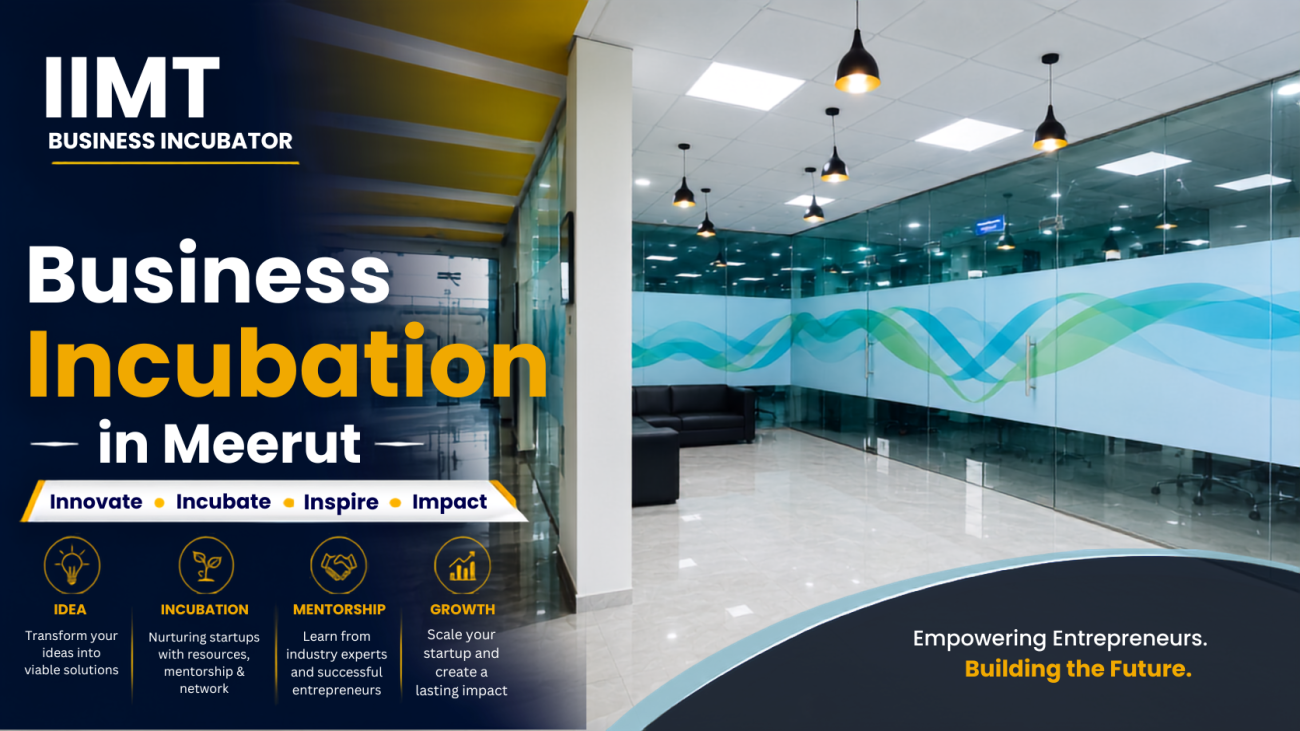
For students interested in business incubation in Meerut, a local entrepreneurship ecosystem can provide opportunities to connect with mentors, networks, industry participants, and other aspiring entrepreneurs.
Being part of a nearby startup community can also make it easier for students to participate in entrepreneurship activities while continuing their academic education. Local incubation can encourage innovation, student-led ventures, networking, and practical exposure.
How Students Can Begin Their Entrepreneurial Journey
Students do not need to wait until graduation to explore entrepreneurship. A practical starting roadmap is:
- Identify a real world problem.
- Develop a potential solution.
- Research customers and competitors.
- Test the idea through feedback.
- Create a basic business model.
- Develop a prototype or MVP.
- Seek expert mentorship.
- Explore incubation opportunities.
- Prepare a business pitch.
- Investigate suitable funding opportunities.
- Launch the solution.
- Measure results and improve.
The objective is not simply to start a company quickly. It is to learn how to identify problems, test assumptions, understand customers, and build sustainable solutions.
Frequently Asked Questions
What is a business incubator for students?
A business incubator provides structured support to students and early-stage entrepreneurs through resources such as mentorship, training, infrastructure, networking, business guidance, and startup development support.
How does a university business incubator help students?
It can help students move from an initial idea toward validation, business planning, prototyping, networking, and potential launch while developing practical entrepreneurial skills.
What does IIMT Business Incubator Foundation do?
The foundation provides support areas including business consulting, co-working facilities, mentoring, funding assistance, workforce development, and IPR support, along with pre-incubation and incubation related facilities.
Can students develop startups while studying?
Yes. Students can explore startup ideas alongside their education, subject to their academic commitments and the requirements of the relevant incubation program.
What support can students receive from a business incubator?
Support can include mentoring, training, infrastructure, business consulting, networking, market guidance, funding awareness or assistance, and intellectual property support.
How can entrepreneurship improve career opportunities?
Entrepreneurship can help students develop transferable skills such as leadership, communication, problem-solving, project management, sales, marketing, financial awareness, and networking.
What is business incubation in Meerut?
Business incubation in Meerut refers to structured support available to entrepreneurs and innovators in the city and surrounding region to help develop ideas, businesses, and startups.
How can students start a business idea through an incubation program?
Students can begin by identifying a problem, validating their idea, developing a business model, seeking mentorship, exploring incubation, creating a prototype, and investigating suitable funding opportunities.
Conclusion
University education becomes more practical when students have opportunities to apply their knowledge beyond the classroom. Entrepreneurship ecosystems can help students develop innovation, leadership, communication, business understanding, and problem-solving skills.
The IIMT University Business Incubator and IIMT Business Incubator Foundation provide an environment focused on incubation, mentorship, training, infrastructure, business guidance, and entrepreneurship support. For students with innovative ideas, these resources can provide a structured pathway to explore startup development while building skills that remain valuable across different careers.
Students interested in entrepreneurship can explore the available programs and support offered by the IIMT Business Incubator Foundation and take the first step toward developing their ideas into practical solutions.



2 thoughts on “IIMT University Business Incubator: Student Startup Guide”